In recent years, artificial intelligence has rapidly evolved from a conceptual innovation into a practical tool within finance. What was once limited to automation and data processing has expanded into systems capable of assisting in financial modelling, valuation, and analytical workflows.
Today, AI can help build financial models, process large datasets, generate forecasts, and even suggest valuation outputs in a matter of minutes. However, despite this progress, its role remains fundamentally supportive rather than substitutive.
At its current stage, AI does not replace financial expertise—it amplifies it. Understanding this distinction is essential.
The Current State of AI in Financial Modelling and Valuation
AI is now firmly embedded in the financial toolkit. From large language models to specialized platforms, these tools are increasingly used to support analysts in building models, conducting research, and performing valuations.
Modern AI systems can:
- Process large volumes of financial data rapidly
- Automate repetitive modelling tasks
- Generate draft financial models or frameworks
- Run multiple scenarios efficiently
However, these outputs should be understood for what they are: drafts or preliminary structures.
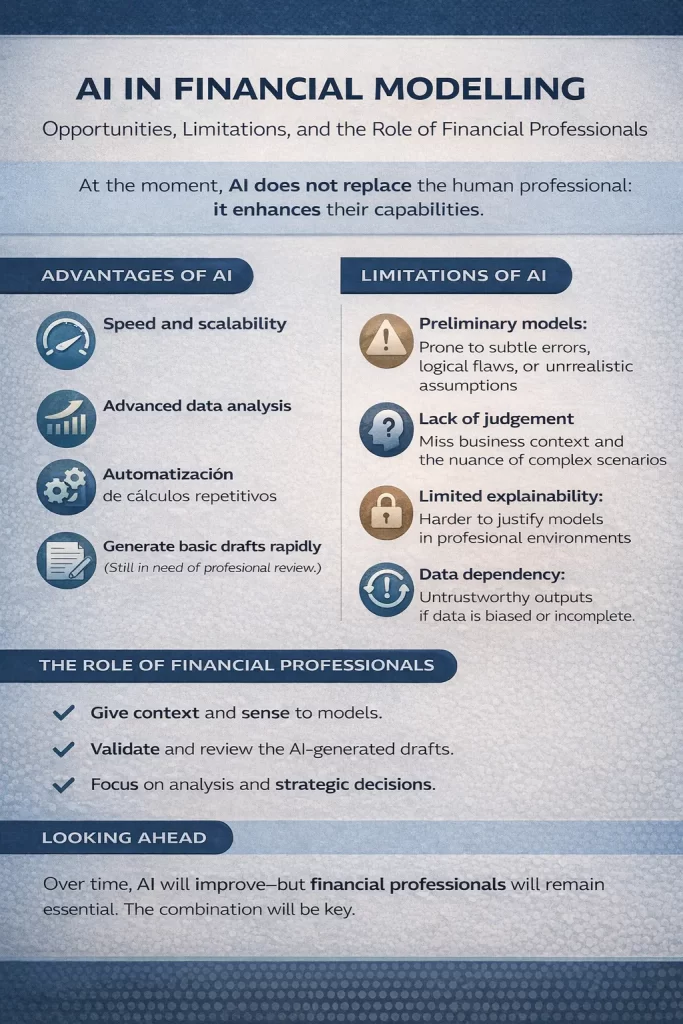
AI-generated models today are not consistently reliable as standalone, decision-ready tools. They often lack the depth, consistency, and contextual understanding required for real-world applications such as investment decisions, transactions, or strategic planning.
As a result, human professionals remain essential—not only to review and validate models, but to structure them properly, define assumptions, and ensure they reflect the underlying business reality.
The Advantages of AI in Financial Modelling
The value of AI in financial modelling lies primarily in how it enhances efficiency and workflow.
First, speed and productivity. Tasks that previously required hours—or even days—can now be completed in a fraction of the time. AI can assist in structuring models, organizing data, and generating initial outputs almost instantly.
Second, scalability. AI enables rapid scenario analysis, allowing professionals to test multiple assumptions—growth rates, margins, discount rates—more efficiently than traditional approaches.
Third, data processing capabilities. AI can handle large volumes of structured and unstructured data, improving the analytical base and reducing manual effort.
Fourth, automation of repetitive tasks. By reducing time spent on mechanical processes, AI minimizes operational errors and increases consistency.
Finally, accessibility—at a preliminary level. AI allows non-experts to generate basic or initial financial models. However, these outputs are typically high-level, incomplete, or structurally limited, and should not be considered fully reliable for decision-making without professional review. In practice, AI does not eliminate the need for expertise—it frees up time for it.
The Limitations and Risks
Despite its advantages, AI introduces important limitations that reinforce the need for human oversight.
A key issue is reliability. AI-generated models can contain structural inconsistencies, incorrect assumptions, or subtle logical errors. These are often not immediately visible and require experienced professionals to identify and correct.
Closely related is the lack of judgment. Financial modelling is not purely technical—it involves interpretation, context, and experience. AI can generate outputs, but it does not truly understand business dynamics.
Another important limitation is lack of explainability. In professional environments, models must be transparent, auditable, and defensible. AI-generated outputs do not always meet these standards without further refinement.
There is also data dependency. AI relies on the quality and completeness of input data. Inaccurate or biased data leads to unreliable outputs.
Finally, there is a risk of false confidence. The sophistication and speed of AI-generated results can create the illusion of accuracy, leading users to over-rely on outputs that have not been properly validated.
The Role of AI in Valuation
In valuation, AI can support both intrinsic approaches (such as DCF) and relative approaches (multiples and comparables).
It can assist in:
- Estimating cash flow projections based on historical patterns
- Identifying comparable companies across large datasets
- Calculating and benchmarking valuation multiples
However, valuation is highly sensitive to assumptions. Growth rates, discount rates, peer selection, and business understanding require professional judgment.
AI can support the process—but it cannot replace the expertise required to interpret and validate results.
Looking Ahead: What to Expect and When
The evolution of AI in financial modelling is already underway. The key question is not whether it will transform the field, but how its role will evolve alongside human expertise.
In the short term (1–3 years), we can expect:
- Deeper integration of AI into financial tools and workflows
- More efficient automation of repetitive modelling tasks
- Improved support for scenario analysis
In the medium term (3–5 years):
- More structured and reliable AI-assisted modelling outputs
- Better integration of real-time data into financial models
- Increased use of AI in analytical and decision-support processes
In the longer term (5–10 years):
- More advanced AI-assisted modelling systems
- Hybrid workflows combining AI generation with human validation
- Greater standardization of AI-supported financial processes
Even in this longer horizon, the role of the financial professional is unlikely to disappear. If anything, it will become more important—focused less on building models mechanically, and more on interpreting, validating, and guiding them.
Final Thoughts
AI is transforming financial modelling—but not replacing it.
It is accelerating processes, improving efficiency, and expanding analytical capabilities. At the same time, it reinforces the importance of human expertise.
The real value lies in the combination: AI as a tool, and the financial professional as the decision-maker. Those who can effectively integrate both will not only work faster—but better.
A Practical Note
In practice, the most effective financial modelling approach today is a hybrid one.
AI can support model creation, accelerate workflows, and enhance analysis. But robust, decision-ready models still require professional structure, validation, and judgment.
Rather than replacing expertise, AI allows professionals to focus on higher-value activities: deeper analysis, better assumptions, and more informed decision-making.
If you are building financial models, performing valuations, or exploring how to integrate AI into your workflows, combining technology with financial expertise remains the most reliable approach.
For more advanced or tailored needs, a structured and professionally developed model can make a meaningful difference.