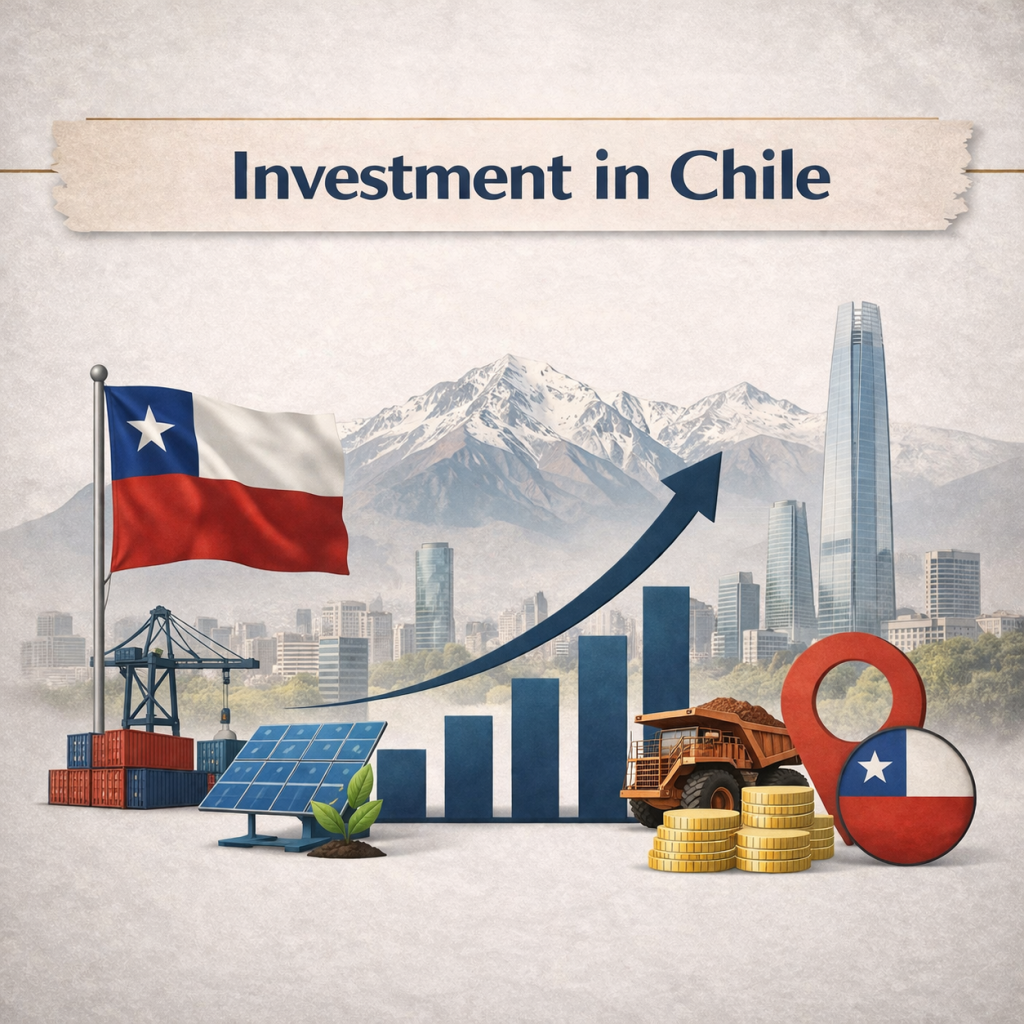
Over the past decade, Chile has consolidated its position as one of Latin America’s most stable and investment-friendly economies. Known for its strong institutional framework, open market policies, and abundant natural resources, the country continues to attract both regional and global investors.
For businesses, startups, and entrepreneurs, understanding where to invest in Chile—and how investment trends are evolving—is key to identifying sustainable growth opportunities in the region.
A Decade of Stability with Strategic Evolution
Chile’s investment landscape has historically been defined by macroeconomic stability and openness to foreign capital.
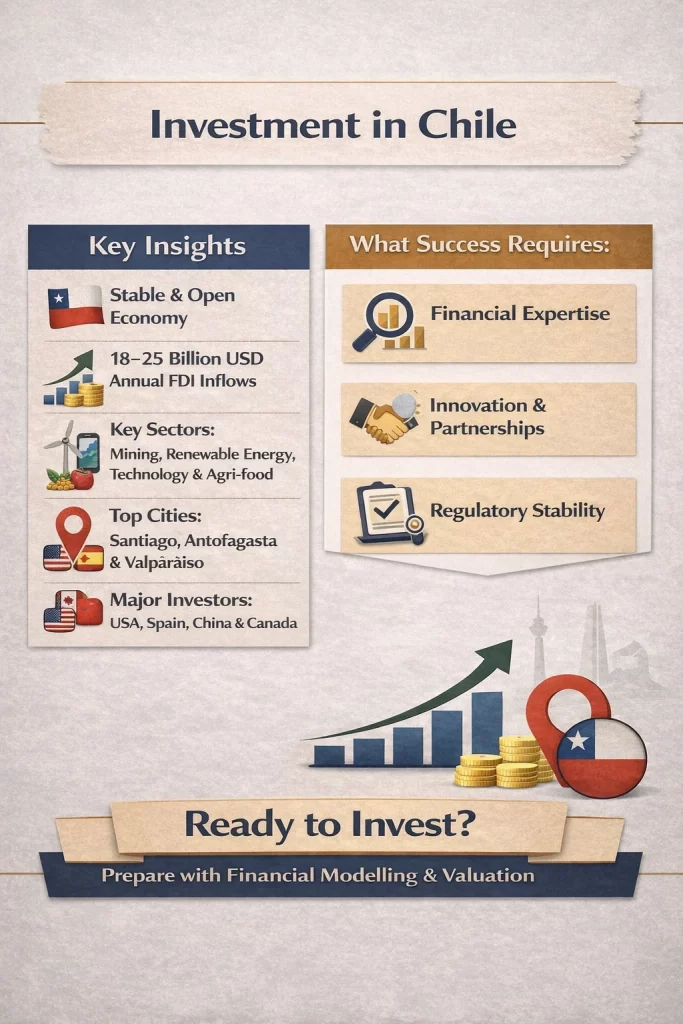
Over the last decade, foreign direct investment (FDI) inflows have remained relatively consistent, often ranging between $10–20 billion annually, with fluctuations driven by commodity cycles and global conditions. Despite periods of political and economic uncertainty, Chile has maintained its reputation as a reliable investment destination.
More recently, the country has been undergoing a gradual transition—expanding beyond traditional sectors into renewable energy, technology, and services.
Public and Private Investment: A Market-Oriented Model
Chile’s investment model is largely driven by private capital, supported by a stable regulatory environment.
Public investment plays an important role in infrastructure, energy transition, and social development, but the private sector remains the main engine of economic activity. This has historically made Chile one of the most market-oriented economies in Latin America.
In recent years, public-private collaboration has increased, particularly in large infrastructure and energy projects.
Where to Invest in Chile: Sector Opportunities
Investment in Chile continues to be strongly linked to its natural resource base, but is becoming increasingly diversified.
Mining remains a cornerstone of the economy, particularly copper and lithium, positioning Chile as a global leader in critical resources for the energy transition.
At the same time, renewable energy has emerged as one of the most dynamic sectors. The country—especially the Atacama Desert—offers some of the best solar energy conditions in the world, attracting significant international investment.
Additional sectors gaining traction include infrastructure, logistics, financial services, and a growing technology and startup ecosystem.
For businesses, aligning with both traditional strengths and emerging sectors is key to accessing opportunities.
Who Is Investing in Chile?
Chile attracts a diverse range of international investors.
The United States, Canada, China, and European countries are among the main sources of foreign investment, particularly in mining, energy, and infrastructure. These investors are drawn by Chile’s regulatory stability, resource base, and long-term growth potential.
Domestic investment also plays an important role, with local companies and institutional investors actively participating in key sectors.
Chile as an International Investor
While Chile is primarily a recipient of investment, its companies are also expanding internationally, particularly within Latin America.
Chilean firms have established a strong regional presence in sectors such as retail, finance, and infrastructure, reflecting a gradual process of internationalization.
For growing businesses, this highlights the importance of regional expansion as part of long-term strategy.
Best Cities and Regions for Investment in Chile
Investment in Chile is both centralized and regionally specialized.
Santiago is the country’s financial and business hub, concentrating corporate headquarters, financial institutions, and the majority of startup and investment activity.
Beyond the capital, other regions play a critical role.
Antofagasta is at the center of the mining industry, particularly copper, attracting large-scale international investment.
Calama is also a key mining hub, closely linked to some of the world’s largest mining operations.
In addition, northern regions—particularly the Atacama area—are becoming global leaders in solar energy investment, while central and southern regions are gaining relevance in infrastructure and logistics.
Understanding these geographic dynamics is essential when evaluating where to invest in Chile.
What This Means for Businesses and Entrepreneurs
Chile offers a combination of stability and opportunity that is relatively unique in Latin America.
However, investors increasingly expect businesses to demonstrate strong financial discipline, clear growth strategies, and an understanding of both local and global dynamics.
For startups and small businesses, this means combining innovation with solid financial planning.
The Role of Financial Modelling and Valuation
In a market where capital allocation is closely tied to long-term projects and commodity cycles, financial modelling and valuation are critical.
Businesses need to assess investment scenarios, evaluate risks, and communicate clearly with investors. Those that can present structured and credible financial information are better positioned to attract capital and make strategic decisions.
Financial modelling becomes a key tool for navigating both stability and volatility.
Final Thoughts
Chile remains one of the most attractive investment destinations in Latin America, combining institutional strength with sectoral opportunity.
For businesses and entrepreneurs, those who understand where to invest in Chile, align with key industries, and build strong financial foundations will be best positioned to grow.
In a market shaped by both tradition and transformation, clarity and preparation are essential.
How Kea Advisory Can Support Your Growth
At Kea Advisory, we support businesses, startups, and investors navigating investment environments like Chile with clarity and structure.
We provide financial modelling tailored to real business scenarios, company valuation grounded in market realities, and strategic financial analysis to support growth, investment, and expansion decisions.
In a market where long-term planning and sector understanding are critical, having a robust financial framework is not just valuable—it is essential.
If you are evaluating opportunities in Chile or planning to expand into the region, Kea Advisory can help you turn financial complexity into clear, actionable insight.