
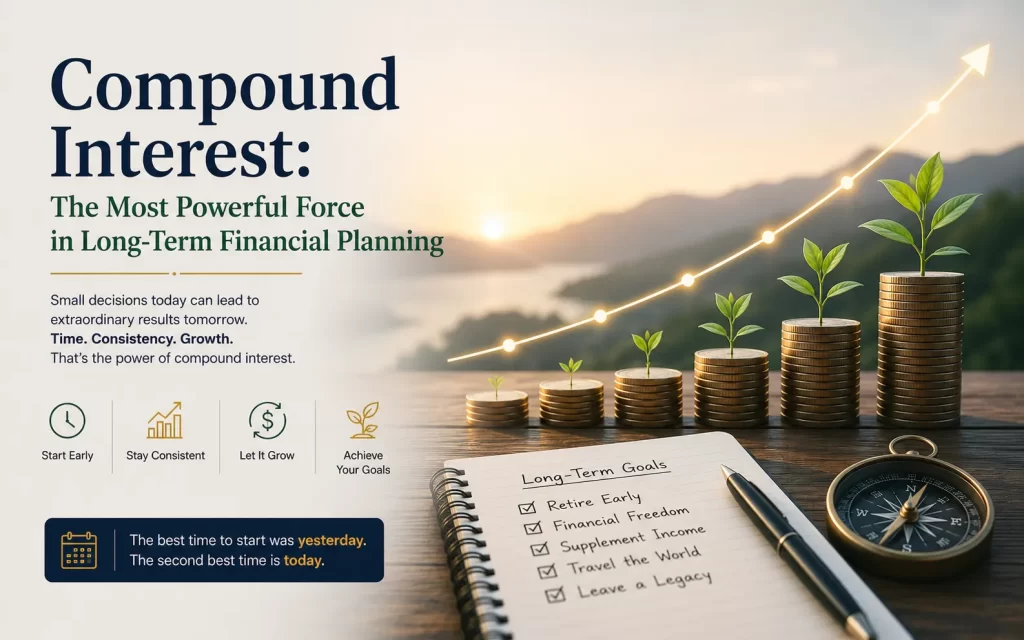
Albert Einstein is often credited with describing compound interest as the eighth wonder of the world. Whether or not he actually said it is open to debate, but the idea behind the statement remains remarkably accurate.
Few concepts have a greater impact on long-term financial outcomes than compound interest.
It is one of the main reasons why some people accumulate significant wealth over their lifetime while others struggle to achieve their financial goals despite earning similar incomes.
Yet compound interest is frequently misunderstood. Many people associate it only with investment returns or savings accounts, without fully appreciating the role it can play in retirement planning, financial independence, income generation and long-term wealth creation.
Understanding how compound interest works is not just useful for investors. It is one of the foundations of effective financial planning.
What Is Compound Interest?
At its simplest, compound interest occurs when returns begin generating additional returns.
Rather than earning a return only on the money you originally invested, you also earn returns on previous gains.
This creates a snowball effect.
In the early years, growth often appears modest. Over longer periods, however, the impact becomes increasingly powerful because each year’s growth is applied to a larger base than the year before.
The key insight is that compound interest is not linear.
It accelerates over time.
That acceleration is what makes it such a powerful force in long-term financial planning.
Why Time Matters More Than Most People Realise
When discussing investing, many people focus on achieving higher returns.
They search for better-performing funds, individual stocks or investment strategies in the hope of increasing performance by a few percentage points.
While returns certainly matter, time is often far more important.
Consider two individuals.
The first begins investing at age twenty-five and continues consistently for many years.
The second waits until age thirty-five before starting but invests larger amounts.
Despite contributing less money overall, the first investor may ultimately accumulate more wealth simply because compound growth has had longer to work.
This illustrates one of the most important principles in personal finance:
The earlier you start, the more powerful compound interest becomes.
Time allows returns to build upon previous returns repeatedly, creating outcomes that can appear surprisingly large when viewed over decades.
Compound Interest and Financial Freedom
Many people pursue financial freedom with a specific target in mind.
They may want to reduce their working hours, retire earlier than expected or simply create greater flexibility in their lives.
Compound interest plays a central role in making these objectives achievable.
Every contribution made today has the potential to grow for years or even decades.
As investments accumulate and generate additional returns, the gap between what has been contributed and what has been earned through growth gradually widens.
Eventually, investment growth can become a more significant driver of wealth than new contributions themselves.
This is often the stage where financial progress begins to feel noticeably faster.
What initially appeared to be slow and incremental growth can evolve into meaningful financial momentum.
The Role of Compound Interest in Retirement Planning
Retirement is perhaps the most common example of compound interest in action.
Most retirement systems, whether public or private, are built around the idea of accumulating assets over a long period of time and allowing investment returns to contribute to future financial security.
The challenge is that retirement may seem distant when someone is in their twenties, thirties or even forties.
As a result, many people underestimate how much difference early action can make.
Starting ten years earlier does not simply provide ten additional years of contributions.
It also provides ten additional years of compound growth.
Over a multi-decade investment horizon, that difference can be substantial.
This is one of the reasons financial planning should focus not only on how much someone saves, but also on when they begin saving.
Compound Interest Is Not Limited to Capital Growth
When people think about compound interest, they often imagine a portfolio growing through increases in market value.
While capital appreciation is certainly one source of compounding, it is not the only one.
Compound growth can be generated through several different mechanisms.
Dividend-paying investments can reinvest income and purchase additional assets, creating future income streams from previous distributions.
Fixed-income investments can reinvest interest payments, increasing future interest generation.
Rental properties can use surplus cash flows to support additional investments.
Even cash deposits can benefit from compounding when interest is reinvested rather than withdrawn.
The common principle is always the same: returns are retained and allowed to generate further returns.
The Hidden Cost of Delaying
One of the least visible financial mistakes is postponing investment decisions.
Unlike a poor investment choice, the cost of delaying is rarely obvious.
Nothing appears to happen.
No money is visibly lost.
However, every year that compound growth is not working is a year that can never be recovered.
The impact of delay becomes increasingly significant when viewed across decades.
This does not mean people should rush into investments without proper consideration.
It simply highlights the value of understanding long-term consequences and recognising that time is a finite resource in financial planning.
Why Compound Interest and Financial Planning Go Hand in Hand
Compound interest is most effective when supported by a structured plan.
The concept itself is powerful, but its benefits are maximised when combined with consistent saving, realistic assumptions and long-term decision-making.
This is where financial planning becomes particularly important.
Understanding how savings, investments, future income and future expenses interact over time allows individuals to see whether their current trajectory is likely to support their long-term objectives.
Rather than focusing on individual investment decisions in isolation, effective planning considers the broader financial picture.
Looking Beyond Today’s Decisions
One of the challenges of personal finance is that today’s decisions often produce consequences many years in the future.
The decision to save, invest or delay action may have little visible impact next month.
Over ten, twenty or thirty years, however, the outcome can be dramatically different.
That is one of the reasons we developed Clarity – Financial Decision Lab.
The tool helps users project income, expenses, assets and liabilities over time, allowing them to understand how different decisions may influence their future financial position.
Because compound interest is ultimately a long-term phenomenon, its true value becomes visible only when viewed across the full financial journey rather than through the lens of today’s circumstances.
A Simple Idea with Extraordinary Consequences
Compound interest is not a complex financial strategy.
It is a simple mathematical principle.
Yet its implications are extraordinary.
It rewards consistency more than perfection.
It rewards patience more than prediction.
And perhaps most importantly, it rewards those who give it enough time to work.
Whether your goal is retirement, financial independence, building additional income streams or simply creating greater financial flexibility, compound interest is likely to be one of the most important factors influencing your success.
The challenge is not understanding that compound interest exists.
The challenge is giving it the time it needs to transform small decisions today into meaningful opportunities tomorrow.