
For many people, investing begins with a simple question:
“What is the best investment?”
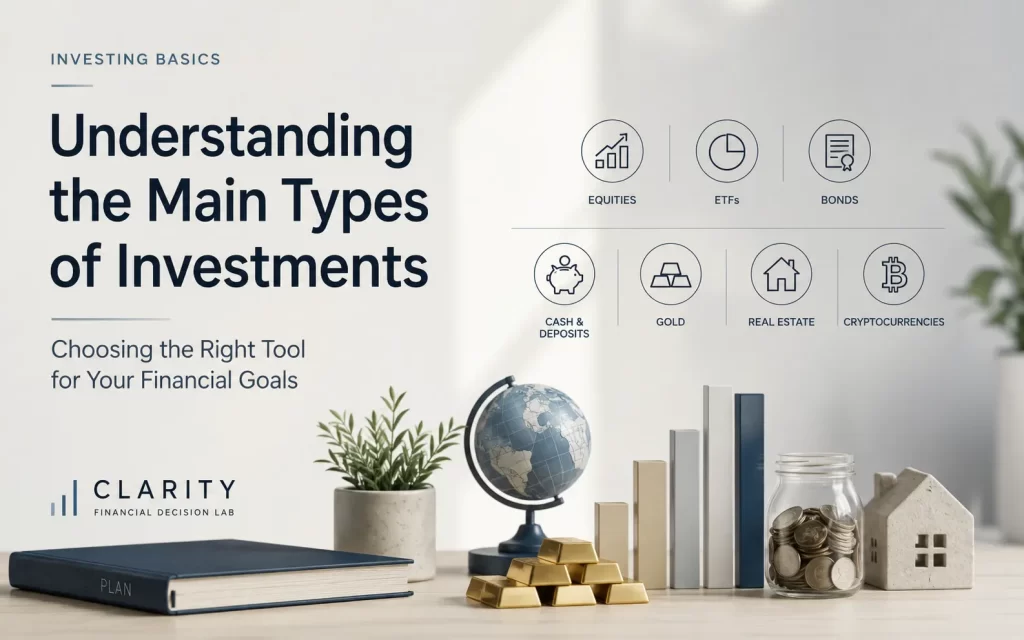
It is an understandable place to start. With thousands of investment opportunities available—from shares and ETFs to government bonds, gold and cryptocurrencies—it is natural to look for the option that offers the highest return.
The reality, however, is that there is no universally “best” investment.
Every asset class has different characteristics, different levels of risk and different roles within a financial plan. The investment that makes perfect sense for one person may be entirely inappropriate for another.
A young professional saving for retirement in thirty years has very different objectives from someone building a deposit for a house or generating additional income during retirement.
This is why successful investing rarely begins by choosing an investment.
It begins by understanding your financial objectives.
Different Investments Exist for Different Reasons
Every investment involves balancing several factors.
Expected return.
Risk.
Liquidity.
Income generation.
Investment horizon.
Some assets are designed to preserve capital. Others aim to generate long-term growth. Some produce regular income, while others may offer little or no cash flow but greater appreciation potential.
Understanding these differences is often far more valuable than searching for the “highest-performing” investment.
The right investment is not necessarily the one that has delivered the strongest historical returns.
It is the one that best supports the financial objective you are trying to achieve.
Equities: Investing in Businesses
Equities, also known as shares or stocks, represent ownership in a company.
When someone buys shares in businesses such as Apple, Microsoft or Nestlé, they become a shareholder and participate in the future success—or failure—of that business.
Historically, equities have been one of the strongest sources of long-term wealth creation, although they can experience significant short-term volatility.
For example, an investor purchasing £10,000 of shares in a single company may benefit from strong growth if the business performs well. Equally, poor business performance could lead to substantial losses.
For this reason, individual shares often suit investors with long investment horizons who are comfortable accepting fluctuations in exchange for higher long-term growth potential.
ETFs: Diversification Made Simple
Exchange Traded Funds (ETFs) have become one of the most popular investment vehicles for individual investors.
Rather than purchasing shares in a single company, an ETF typically invests in dozens, hundreds or even thousands of businesses through a single investment.
For example, an ETF tracking the S&P 500 provides exposure to approximately 500 of the largest listed companies in the United States.
This diversification helps reduce company-specific risk while maintaining exposure to long-term economic growth.
Although ETFs still fluctuate with financial markets, they offer a relatively simple and cost-effective way to build diversified portfolios.
Fixed Income: Stability and Predictable Income
Fixed-income investments, such as government or corporate bonds, are generally designed to provide greater stability than equities.
Instead of purchasing ownership in a business, investors lend money to governments or companies in exchange for regular interest payments.
Historically, fixed-income investments have produced lower long-term returns than equities but have often experienced lower volatility.
They may therefore play an important role for investors seeking more predictable income or lower portfolio risk, particularly as they approach retirement.
However, bonds are not risk-free. Inflation, interest rate movements and issuer credit quality can all influence their value.
Cash and Deposits: Safety and Liquidity
Cash savings and bank deposits remain an essential part of most financial plans.
Although they rarely generate the highest returns over long periods, they provide something many other investments cannot: immediate access to capital.
This liquidity makes them particularly valuable for emergency funds, planned short-term expenses or financial security during periods of uncertainty.
The trade-off is that cash may lose purchasing power over time if inflation exceeds the interest earned.
For this reason, cash often serves as a foundation for financial stability rather than a long-term wealth-building strategy.
Gold: Diversification Rather Than Income
Gold has been regarded as a store of value for centuries.
Unlike shares or bonds, it does not generate income through dividends or interest.
Instead, investors often use gold as a way of diversifying portfolios or protecting wealth during periods of economic uncertainty or inflation.
Its role is therefore different from assets designed primarily to generate long-term income or capital growth.
Whether gold deserves a place in a portfolio depends on an investor’s objectives, risk profile and overall strategy.
Real Estate: Combining Income and Capital Growth
Property remains one of the most familiar forms of investment.
Whether purchasing residential or commercial real estate, investors often seek a combination of rental income and long-term capital appreciation.
Real estate can also provide diversification, particularly for investors whose wealth is otherwise concentrated in financial assets.
However, property investments require significant capital, involve ongoing costs and are generally far less liquid than listed investments.
As with every asset class, the decision should be driven by financial objectives rather than popularity.
Cryptocurrencies: High Potential, High Uncertainty
Cryptocurrencies represent one of the newest and most widely discussed asset classes.
Assets such as Bitcoin and Ethereum have attracted significant attention because of their substantial price movements and long-term growth potential.
At the same time, they remain highly volatile and are subject to considerable regulatory, technological and market uncertainty.
For some investors, cryptocurrencies may represent a small component of a diversified portfolio.
For others, they may not be appropriate at all.
As with any investment, understanding both the opportunities and the risks is essential before committing capital.
There Is No Perfect Investment
One of the biggest misconceptions in investing is the belief that there is a single investment capable of outperforming all others in every situation.
In reality, different assets exist because they solve different financial needs.
Someone saving for retirement in thirty years may prioritise long-term growth.
Someone planning to purchase a home within three years may place greater importance on capital preservation and liquidity.
An investor seeking regular income may build a portfolio very differently from someone focused entirely on future wealth accumulation.
The objective should determine the investment—not the other way around.
Financial Planning Before Investment Selection
Choosing investments should be one of the final steps in financial planning, not the first.
Before deciding where to invest, it is worth understanding why you are investing in the first place.
Are you building wealth for retirement?
Saving for a home?
Planning your children’s education?
Creating additional income?
Building a financial legacy for future generations?
Each objective may require a different combination of assets, investment horizons and risk levels.
At Clarity – Financial Decision Lab, users can project future income, expenses, assets and liabilities to understand how investing fits within their broader financial plan.
Because successful investing is not about finding the perfect investment.
It is about selecting the investments that best support the future you want to create.