
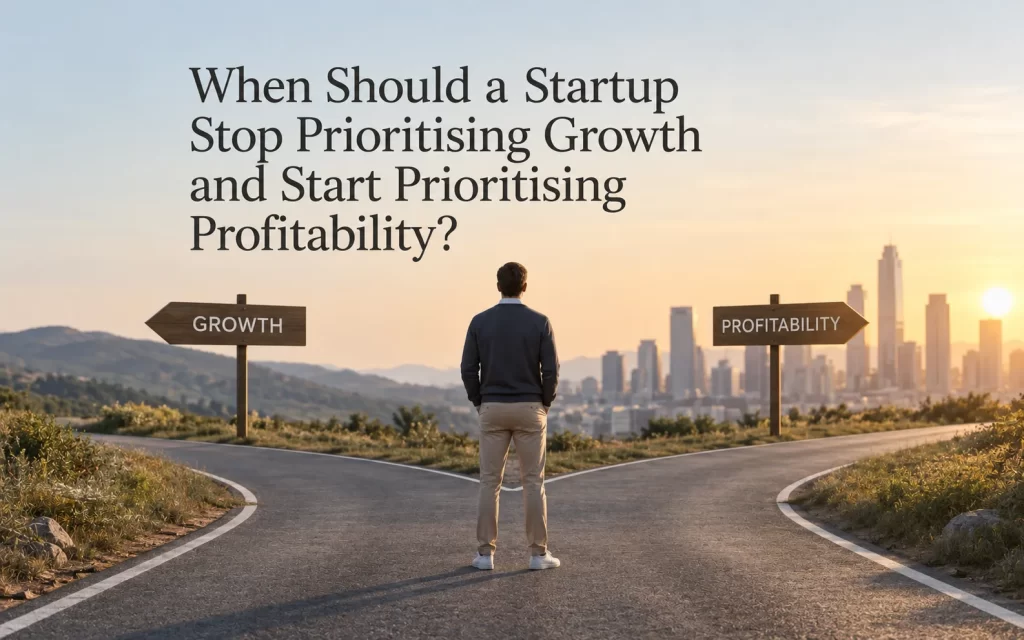
For a startup, growth is usually the objective.
More customers. More revenue. More markets. More employees. More funding. A larger team and a larger addressable market.
And for good reason. In the early stages of a company, growth can be essential to proving that the business model works and that there is an opportunity worth pursuing. Investors often reward it, employees are attracted by it, and founders understandably want to build as quickly as possible.
But at some point, the question changes.
It is no longer simply how fast can we grow? It becomes how much does that growth cost, and is it creating enough value to justify it?
That transition is one of the most important financial decisions a startup will eventually face.
The difficulty is that there is no universal revenue or funding milestone at which a company should suddenly become profitable. A SaaS company with strong retention, high gross margins and a large market may rationally continue investing aggressively for years. Another company with weaker unit economics, limited access to capital or a less scalable business model may need to prioritise profitability much earlier.
The answer therefore cannot be found in a simple rule such as “grow until €10 million in revenue” or “become profitable after Series B”. It depends on what the company is buying with its losses.
Growth is not free
One of the easiest mistakes to make in a high-growth company is to look at revenue growth without looking at the financial resources required to produce it.
Imagine a startup increasing revenue by 80% in a year. On the surface, that sounds like excellent performance. But suppose achieving that growth requires doubling the sales team, opening new markets, increasing marketing expenditure and holding significantly more inventory.
Revenue has grown by 80%, but the capital required to support the business may have grown considerably faster.
This is why growth should never be analysed independently from cash generation.
A company can be growing rapidly and still be moving further away from financial sustainability. It can also be profitable on an accounting basis while consuming significant amounts of cash because customers pay later, inventory needs to be financed or investment requirements are increasing.
The important question is therefore not whether the company is growing.
It is what the company is receiving in return for the capital it is consuming.
The point is not to maximise profitability either
This does not mean that every startup should pursue profitability as soon as possible.
There is an equally important mistake on the other side: treating profitability as the objective simply because it makes the financial statements look healthier.
For a company with a genuinely attractive market opportunity, deliberately sacrificing short-term profitability can create substantial long-term value.
If investing €1 million today can generate an additional €5 million of future revenue, with attractive margins and a high probability of retention, reducing that investment simply to reach profitability sooner may destroy value rather than create it.
This is particularly important in competitive markets. A startup may need to invest ahead of demand to establish a market position, develop its technology, build distribution or achieve sufficient scale.
In those circumstances, losses are not necessarily a sign of a bad business.
They may be the price of building one.
The real problem begins when the relationship between investment and future value becomes unclear.
So when should the priority change?
A startup should start questioning its growth strategy when additional growth requires increasingly more capital without a corresponding improvement in the economics of the business.
This can happen in several ways.
Customer acquisition costs may rise while lifetime value stops improving. Gross margins may deteriorate as the company enters new markets. Each additional unit of revenue may require disproportionately more working capital. Hiring may continue faster than productivity. Or the company may simply discover that the next stage of growth is much more expensive than the previous one.
At that point, the question should move from “How quickly can we grow?” to “What return are we generating on the capital we are deploying to grow?”
That is a much more demanding question.
It requires understanding not only revenue and EBITDA, but also cash requirements, working capital, investment needs, customer economics, financing capacity and the assumptions behind future growth.
It also requires considering the alternative use of capital.
If the company can deploy another €5 million and generate substantial value by accelerating growth, continuing to invest may be the right decision. If the same €5 million is increasingly producing smaller incremental returns, reaching profitability may become the better allocation of capital.
The decision is therefore not really growth versus profitability.
It is about capital allocation.
The transition should be planned, not forced
One of the most dangerous situations for a growth-stage startup is being forced to prioritise profitability because external financing suddenly becomes unavailable.
By then, the company may have very limited room to manoeuvre.
Hiring decisions have already been made. Contracts have been signed. New markets have been entered. Fixed costs have increased. And reducing expenditure quickly may damage the very growth engine the company was trying to protect.
A stronger approach is to model the transition before it becomes necessary.
Management should understand what happens to cash consumption under different growth assumptions, what level of revenue is required to reach break-even, how much additional funding would be needed, and which costs could realistically be reduced if market conditions deteriorated.
This does not mean predicting exactly what will happen.
It means understanding the consequences of different decisions.
A startup might discover, for example, that maintaining 70% growth requires another funding round, while reducing growth to 45% allows the company to reach cash-flow break-even within eighteen months. Neither scenario is automatically better.
The right choice depends on the opportunity available, the expected return on additional capital, the company’s financing alternatives and the risks involved.
That is where financial modelling becomes particularly valuable: not as a prediction of the future, but as a way of understanding the financial consequences of the strategy.
Growth should have an economic purpose
The best startups do not eventually choose between growth and profitability because one is good and the other is bad.
They continuously ask whether the next euro invested in the business is likely to create more value than it costs.
Sometimes the answer will be yes, and aggressive growth will make sense.
Sometimes the market opportunity has changed, capital has become more expensive, or the economics of additional growth have deteriorated. In those circumstances, protecting cash generation and moving towards profitability may be the better strategy.
The important milestone is therefore not a particular revenue figure, funding round or age of the company.
It is the moment when the expected value created by additional growth is no longer sufficient to justify the capital and risk required to achieve it. That is when a startup should stop asking how fast it can grow—and start asking whether it is growing well.