
In an increasingly complex regulatory environment, staying ahead of legal and tax developments is no longer optional—it is a strategic necessity. Across Spain and the European Union, recent reforms are reshaping how companies, freelancers, and startups operate, report, and scale.
This article outlines the most relevant regulatory and tax changes affecting businesses in 2025–2026, with a focus on practical implications.
1. The Rise of Digital Tax Compliance: E-invoicing and Real-Time Reporting
One of the most significant shifts is the transition toward fully digital tax compliance systems.
Spain: VeriFactu and Mandatory Digital Invoicing
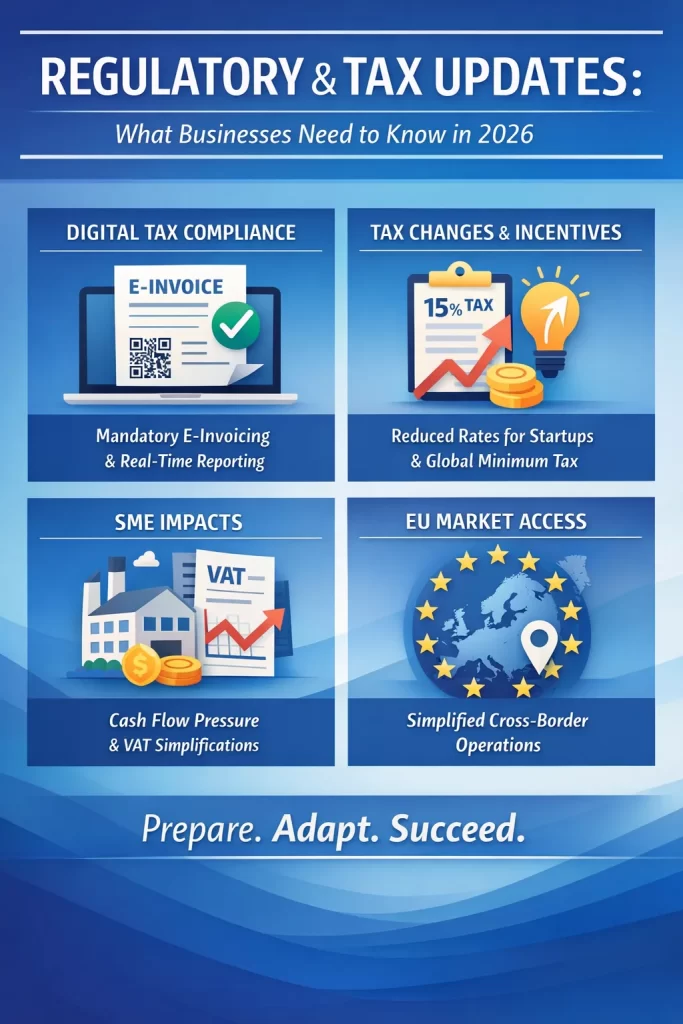
From July 2026, Spain will require freelancers and businesses to adopt certified invoicing systems under the VeriFactu framework. These systems must ensure:
- Real-time or near real-time reporting to the Tax Agency
- Data integrity and traceability
- Standardized formats, including QR codes
This reform is part of Spain’s broader anti-fraud strategy and represents a major operational change for SMEs and freelancers.
European Union: VAT in the Digital Age (ViDA)
At the EU level, the VAT in the Digital Age (ViDA) reform introduces:
- Mandatory e-invoicing for cross-border B2B transactions (from 2030)
- Real-time digital reporting systems
- A single VAT registration system across EU countries
Implication:
Companies must invest in digital infrastructure and rethink their finance and reporting processes—this is no longer just compliance, but a core financial capability.
2. Taxation Changes: Incentives, Minimum Taxes, and New Obligations
Corporate Tax and Startup Incentives (Spain)
Spain maintains a standard corporate tax rate of 25%, with specific incentives for startups and SMEs.
Under the Startup Law:
- Certified startups can benefit from a reduced 15% corporate tax rate for up to four years
- Corporate tax payments can be deferred (12 months in the first profitable year)
These measures aim to promote entrepreneurship and attract international talent.
EU Minimum Tax (Pillar Two)
Large multinational groups must now comply with a minimum effective tax rate of 15% under OECD/EU rules.
Implication:
While this mainly affects large groups, it is highly relevant for startups planning international expansion or future exits.
3. VAT Simplification for SMEs and Cross-Border Activity
The EU has introduced a new SME VAT regime (effective 2025):
- VAT exemption thresholds harmonized up to €85,000
- Simplified reporting for cross-border small businesses
Implication:
For startups and digital businesses, cross-border scalability within the EU becomes more feasible—but requires careful planning of thresholds and compliance.
4. Regulatory Simplification vs. New Compliance Burdens
EU “28th Regime” for Startups (Upcoming)
The European Commission is working on a single regulatory framework for startups, often referred to as the “28th regime,” which aims to:
- Harmonize corporate, tax, and insolvency rules
- Enable companies to operate seamlessly across the EU
Sustainability Regulation Adjustments
Recent developments indicate a more proportional approach to sustainability rules, limiting their scope to larger companies:
- Higher thresholds for applicability
- Reduced compliance burden for SMEs
Implication:
While large corporations still face increasing ESG obligations, SMEs and startups may benefit from reduced regulatory pressure—at least in the short term.
5. Sector-Specific and Emerging Regulations
Digital Economy and Platforms
The Digital Services Act (DSA) introduces new obligations for online platforms, including:
- Transparency requirements
- Content moderation accountability
- Risk-based compliance depending on size
Energy and Windfall Taxes (Emerging Risk)
There is ongoing discussion at the EU level around windfall taxes on energy companies, which could impact investment incentives and regulatory certainty.
6. Key Regulatory and Tax Impacts Specifically Affecting SMEs
While many regulatory developments are often discussed in the context of large corporations or multinational groups, small and medium-sized enterprises (SMEs) are among the most affected—both positively and negatively.
6.1. Increased Compliance Burden from Digitalization
The transition toward mandatory digital invoicing and real-time tax reporting represents a disproportionate challenge for SMEs.
Unlike large companies, SMEs often:
- Lack dedicated finance and IT teams
- Operate with fragmented or manual accounting systems
- Face tighter cost constraints
Practical impact:
- Need to invest in compliant invoicing software
- Potential restructuring of administrative processes
- Increased reliance on external advisors
6.2. Cash Flow Pressure from Tax Timing and Reporting
Real-time or near real-time reporting systems can create cash flow challenges, particularly for smaller businesses.
Why this matters:
- Taxes may effectively be assessed sooner
- Less flexibility in correcting or delaying reporting
- Greater exposure to penalties for errors
Example:
Under stricter VAT control systems, timing differences between invoicing and cash collection can strain liquidity—especially in B2B environments with long payment terms.
6.3. Opportunities from Simplified VAT Regimes
Recent EU reforms offer tangible benefits for SMEs engaged in cross-border activities:
- Higher VAT exemption thresholds
- Reduced need for multiple VAT registrations
- Simplified compliance procedures
Practical impact:
- Easier expansion into other EU markets
- Lower administrative costs
- More attractive unit economics for early-stage businesses
6.4. Limited Access to Tax Optimization Compared to Large Corporations
While large companies benefit from complex tax structures and international planning, SMEs face:
- Fewer optimization tools
- Greater exposure to domestic tax rules
- Higher relative effective tax burdens in some cases
Implication:
Strategic financial planning—especially around investment, financing, and growth—is critical.
6.5. Impact of Financing and Reporting Requirements
Regulatory trends are also affecting how SMEs access financing:
- Increased demand for financial transparency from lenders and investors
- Greater importance of standardized financial reporting
- ESG-related considerations beginning to influence credit decisions
Practical impact:
- SMEs need more robust financial models and forecasts
- Higher expectations when seeking financing
- Stronger link between financial planning and capital access
6.6. Labor and Social Security Adjustments (Spain)
In Spain, SMEs are particularly sensitive to:
- Changes in social security contributions (especially for freelancers under the income-based system)
- Increases in minimum wage levels
- Evolving labor regulations
Implication:
These changes directly impact cost structures and profitability, making workforce planning a key financial lever.
6.7. Gradual Relief from ESG and Sustainability Regulation
Recent EU adjustments suggest a more proportional approach to sustainability regulation, with SMEs facing:
- Reduced reporting requirements
- Higher thresholds before obligations apply
Practical impact:
- Lower short-term compliance costs
- More time to adapt
7. What This Means for Businesses, Freelancers, and Startups
Across all these changes, several clear trends emerge:
1. Digitalization is Mandatory
Financial reporting, invoicing, and tax compliance are becoming fully digital and automated.
2. Cross-Border Opportunities Are Increasing
EU initiatives aim to simplify expansion—but require structured financial planning.
3. Tax Planning Is More Strategic Than Ever
From startup incentives to global minimum taxes, taxation is now a key component of business strategy.
4. Regulation Is Both a Risk and an Opportunity
Companies that adapt early can gain a competitive advantage.
Conclusion
The regulatory landscape in Spain and the EU is evolving rapidly, with a clear direction toward digitalization, harmonization, and transparency.
For businesses, freelancers, startups—and especially SMEs—the challenge is not only compliance, but turning regulation into a strategic advantage.
This is where robust financial modelling, scenario analysis, and forward-looking planning become critical tools—not just for understanding the present, but for anticipating what comes next.
How We Can Help
Navigating regulatory change is not just about staying compliant—it’s about making better decisions.
At Kea Advisory, we support companies, SMEs, and entrepreneurs with:
- Custom financial models tailored to your business reality
- Advanced financial analysis to understand risks and opportunities
- Business valuation services for strategic decisions, fundraising, or transactions
Whether you need to adapt to new tax frameworks, plan your growth, or prepare for investors, having a clear and structured financial view is essential.
If you would like to discuss your situation or explore how we can support your business, feel free to get in touch.