
Over the past decade, Spain has quietly redefined its position as an investment destination. Once heavily associated with cyclical sectors such as real estate and tourism, the country has evolved into a more diversified and resilient market—attracting both international capital and increasingly sophisticated domestic investors.
For small businesses, startups, and entrepreneurs, understanding where to invest in Spain—and how investment is evolving—is no longer just informative. It is a strategic advantage.
A Decade of Recovery and Growth
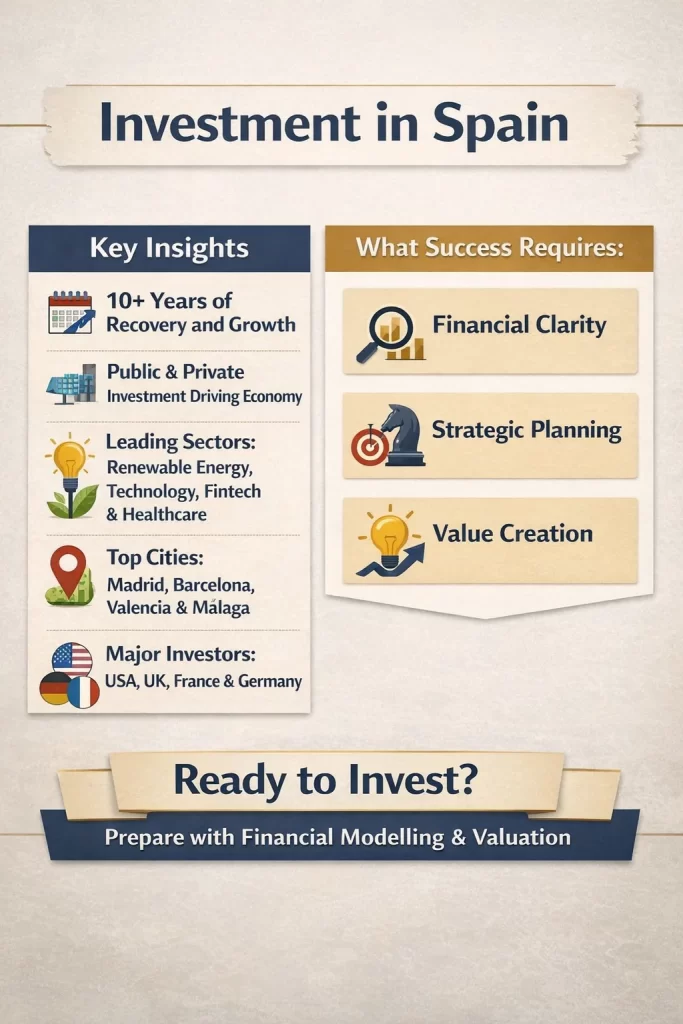
Spain’s current investment landscape is rooted in its post-2012 recovery. Following the European sovereign debt crisis, investment gradually returned as economic stability improved and structural reforms took hold.
Between 2015 and 2019, foreign direct investment (FDI) inflows stabilized at approximately €20–30 billion annually, reflecting renewed international confidence. Although 2020 brought a temporary slowdown due to the pandemic, investment rebounded strongly from 2021 onwards.
More recently, European recovery funds have reinforced this momentum, shifting the focus from cyclical recovery to long-term transformation.
Public and Private Investment: A Strong Combined Driver
One of the defining features of Spain’s investment environment today is the combination of public and private capital.
On the public side, the European Union’s Next Generation EU program has allocated tens of billions of euros to Spain, with a strong focus on digitalization, sustainability, and infrastructure. These funds are not only supporting economic recovery but also reshaping where investment opportunities emerge.
At the same time, private investment remains the main engine of growth. Venture capital, private equity, and corporate investment have expanded significantly over the past decade, particularly in scalable and innovation-driven sectors.
For businesses, this creates a unique environment where public incentives and private capital often align.
Where to Invest in Spain: Sector Opportunities
Investment in Spain is no longer concentrated in traditional sectors alone.
While real estate continues to attract capital, the most dynamic growth is taking place in renewable energy, technology, fintech, and healthcare. Spain has become one of Europe’s leading destinations for renewable energy investment, particularly in solar and wind, supported by both regulation and natural conditions.
At the same time, the country’s startup ecosystem is expanding rapidly, attracting both local and international investors seeking high-growth opportunities.
For entrepreneurs, understanding these sector trends is essential when positioning a business or seeking funding.
Who Is Investing in Spain?
Foreign investment remains a cornerstone of Spain’s economy.
The United States, the United Kingdom, France, and Germany consistently rank among the main sources of capital. These investors are attracted by Spain’s market size, infrastructure, talent pool, and strategic access to the European Union.
In parallel, domestic investment has become more active and sophisticated. Spanish companies and investors are increasingly participating in large transactions and expanding internationally, reflecting a more mature and competitive business environment.
Spain as an International Investor
Spain is not only a destination for capital—it is also a global investor.
Spanish companies have traditionally maintained strong ties with Latin America, but in recent years they have expanded further into Europe and North America. This outward investment reflects both the international ambition and the growing capabilities of Spanish businesses.
For startups and scale-ups, this reinforces an important point: growth increasingly requires an international mindset from an early stage.
Best Cities for Investment in Spain
Investment in Spain is highly concentrated geographically, and understanding the best cities for investment in Spain can be a key strategic decision.
Madrid leads in overall investment volume, particularly in financial services, large corporations, and international capital flows. It remains the country’s primary business and financial hub.
Barcelona has established itself as a leading center for startups and innovation, attracting venture capital and international talent.
Beyond these two major cities, new investment hubs are emerging.
Valencia is gaining strong traction as a startup and scale-up destination, offering a growing tech ecosystem combined with lower operating costs and high quality of life—an increasingly relevant factor for founders and investors.
Málaga is rapidly positioning itself as a technology and innovation hub in Southern Europe. With increasing international interest, strong infrastructure, and a growing presence of tech companies, it is becoming one of the most attractive emerging cities for investment in Spain.
In addition, southern regions are seeing increased investment in renewable energy, further diversifying the country’s geographic investment landscape.
What This Means for Businesses and Entrepreneurs
The Spanish investment environment today offers more opportunities than ever—but also higher expectations.
Access to capital has improved significantly compared to a decade ago, especially for businesses aligned with structural trends such as digitalization, sustainability, and innovation. However, investors are increasingly selective.
To compete effectively, businesses need more than a strong idea. They need financial clarity, structured planning, and a clear path to value creation.
The Role of Financial Modelling and Valuation
In this context, financial modelling and company valuation are no longer optional—they are essential.
Investors expect detailed financial projections, scenario analysis, and a clear understanding of how value is created over time. Businesses that can communicate this effectively are in a much stronger position when raising capital or making strategic decisions.
Financial modelling becomes the bridge between strategy and execution—turning ideas into structured, credible investment cases.
Final Thoughts
Spain has become a more sophisticated, competitive, and opportunity-rich investment environment.
For businesses and entrepreneurs, those who understand where to invest in Spain, identify the right sectors and cities, and support their strategy with strong financial analysis will be best positioned to grow.
If you are evaluating investment opportunities, planning expansion, or preparing to raise capital, a solid financial approach can make a decisive difference—not only in attracting investors, but in building a sustainable and scalable business.
How Kea Advisory Can Support Your Growth
At Kea Advisory, we work with businesses, startups, and entrepreneurs to bring clarity and structure to financial decision-making.
We support our clients through financial modelling tailored to real business scenarios, company valuation grounded in market reality, and strategic financial analysis to support growth, investment, and fundraising.
In an environment where investors expect rigor and transparency, having a well-structured financial foundation is not just an advantage—it is a necessity.
If you are looking to better understand your business, prepare for investment, or make more informed strategic decisions, Kea Advisory can help you turn financial complexity into clear, actionable insight.