Over the past decade, the United States has reinforced its position as the world’s leading investment destination. With the largest capital markets globally, a highly developed financial system, and a culture of innovation, the U.S. continues to attract both domestic and international investors at scale.
For small businesses, startups, and entrepreneurs, understanding where to invest in the United States—and how capital flows are evolving—is not just useful. It is a critical strategic advantage.
A Decade of Scale, Innovation, and Resilience
The U.S. investment landscape is defined by its scale and consistency.
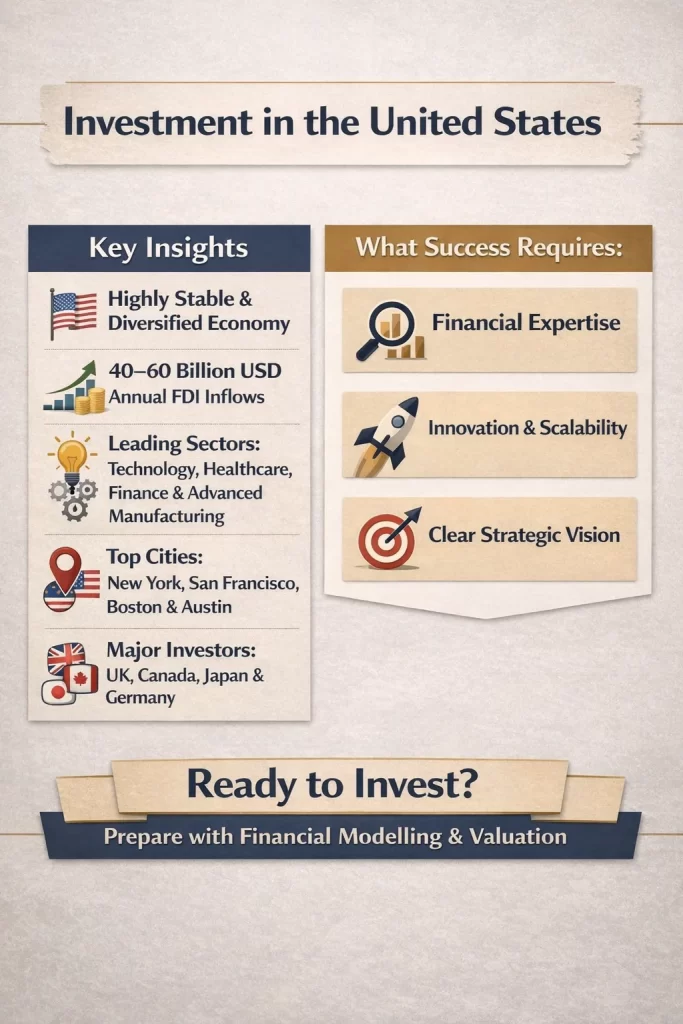
Over the last decade, the country has remained one of the top global recipients of foreign direct investment (FDI), often attracting more than $250–300 billion annually. Even during periods of uncertainty, such as the COVID-19 pandemic in 2020, investment activity proved resilient and rebounded quickly in 2021 and 2022.
This resilience is supported by strong institutional frameworks, deep capital markets, and a continuous pipeline of innovation—particularly in technology and life sciences.
Public and Private Investment: A Powerful Dual Engine
While the United States is traditionally seen as a private capital-driven economy, public investment has played an increasingly important role in recent years.
Large-scale policy initiatives, such as infrastructure programs and energy transition incentives, have mobilized significant capital into sectors like clean energy, advanced manufacturing, and semiconductors. These initiatives are shaping long-term investment trends and creating new opportunities for businesses aligned with national priorities.
At the same time, private investment remains the dominant force. The U.S. hosts the world’s largest venture capital and private equity markets, with billions of dollars deployed annually across startups, scale-ups, and established companies.
The interaction between public support and private capital creates a uniquely dynamic investment environment.
Where to Invest in the United States: Sector Opportunities
Investment in the United States is highly diversified, but certain sectors stand out as key drivers of growth.
Technology remains at the center, particularly in areas such as artificial intelligence, cloud computing, and cybersecurity. Healthcare and biotechnology continue to attract significant capital, supported by innovation and demographic trends.
In addition, renewable energy and energy transition have become major investment themes, with substantial capital flowing into solar, wind, and battery technologies. Advanced manufacturing is also gaining traction, supported by policy incentives and supply chain reshoring.
For entrepreneurs, aligning with these structural trends can significantly increase access to capital.
Who Is Investing in the United States?
The U.S. attracts capital from across the globe.
Major sources of foreign investment include countries such as the United Kingdom, Canada, Japan, Germany, and increasingly sovereign wealth funds from the Middle East and Asia. These investors are drawn by the size of the U.S. market, its legal stability, and its innovation ecosystem.
At the same time, domestic investment is exceptionally strong. U.S.-based institutional investors, private equity firms, and venture capital funds play a dominant role in funding businesses at all stages of growth.
This combination of global and domestic capital creates one of the most competitive investment environments in the world.
The United States as a Global Investor
The United States is not only a recipient of capital but also one of the largest exporters of investment globally.
American companies and investment funds have a significant presence in Europe, Latin America, and Asia, shaping global capital flows. This outward investment reflects both the scale and international reach of U.S. businesses.
For growing companies, this reinforces the importance of thinking globally from an early stage.
Best Cities for Investment in the United States
Investment in the United States is geographically diverse, with several cities emerging as key hubs depending on sector focus.
New York remains the country’s financial capital, leading in finance, private equity, and large-scale transactions. It is a global center for capital allocation and corporate activity.
San Francisco and the broader Silicon Valley area continue to dominate in technology and venture capital, serving as the epicenter of global innovation.
Beyond these established hubs, other cities are rapidly gaining prominence.
Austin has emerged as one of the fastest-growing tech hubs, attracting startups, talent, and corporate investment thanks to its business-friendly environment and lower operating costs.
Miami is increasingly positioning itself as a gateway between North America and Latin America, with growing activity in finance, technology, and entrepreneurship.
These geographic dynamics are critical when deciding where to locate operations, raise capital, or expand a business.
What This Means for Businesses and Entrepreneurs
The U.S. offers unparalleled access to capital—but also demands a high level of sophistication.
Investors expect businesses to demonstrate scalability, strong financial discipline, and a clear path to profitability. Competition for funding is intense, particularly in high-growth sectors.
For startups and small businesses, this means that preparation is key. Having a clear financial strategy is no longer optional—it is essential.
The Role of Financial Modelling and Valuation
In such a competitive environment, financial modelling and company valuation become fundamental tools.
Investors expect detailed projections, scenario analysis, and a clear understanding of key value drivers. Businesses that can present structured, credible financial information are significantly more likely to secure funding and make informed strategic decisions.
Financial modelling connects vision with execution, translating business ideas into tangible, investor-ready plans.
Final Thoughts
The United States remains one of the most attractive and competitive investment environments in the world.
For businesses and entrepreneurs, those who understand where to invest in the United States, align with key sector trends, and build strong financial foundations will be best positioned to succeed.
In a market defined by scale and competition, clarity and preparation make the difference.
How Kea Advisory Can Support Your Growth
At Kea Advisory, we work with businesses, startups, and entrepreneurs to navigate complex investment environments with clarity and confidence.
We support our clients through financial modelling tailored to real business scenarios, company valuation grounded in market reality, and strategic financial analysis to support growth, investment, and fundraising.
In a highly competitive market like the United States, having a robust and well-structured financial framework is not just an advantage—it is essential.
If you are preparing to raise capital, expand into new markets, or evaluate strategic opportunities, Kea Advisory can help you turn financial complexity into clear, actionable insight.