

In today’s increasingly interconnected global economy, geopolitical tensions can quickly translate into financial stress for businesses. The recent escalation involving Iran, rising oil prices, and the potential disruption of critical trade routes such as the Strait of Hormuz are not just macro headlines—they have direct and immediate implications for corporate finance.
For companies reliant on external financing, these developments are reshaping refinancing conditions and putting pressure on financial covenants in ways that demand proactive management and robust financial modelling.
1. The Transmission Mechanism: From Geopolitics to Balance Sheets
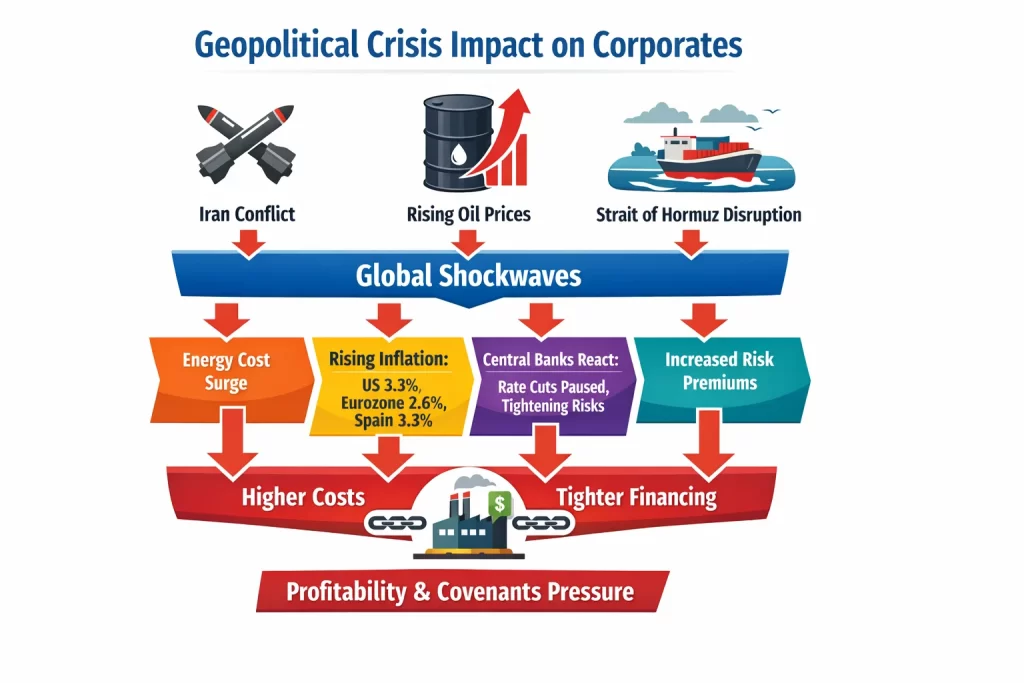
At first glance, geopolitical conflict may seem distant from corporate financial structures. However, the transmission channels are both rapid and material:
- Energy price shocks increase operating costs, particularly in energy-intensive sectors such as:
- Airlines and logistics, where fuel is a primary cost driver
- Chemicals and manufacturing, which rely heavily on energy as both input and process cost
- Food and agriculture, where fuel, fertilizers, and transport costs are tightly linked to oil prices
- Inflationary pressures erode margins and reduce real cash flow generation. Recent data illustrates how quickly this effect materializes:
- In the United States, CPI rose approximately 0.9% month-on-month in March 2026, pushing annual inflation to around 3.3%, largely driven by fuel price increases
- In the Eurozone, inflation expectations have been revised upward, with projections around 2.6% for 2026, and temporary spikes above 3% driven by energy costs
- In Spain, inflation has accelerated to approximately 3.3% in March, reflecting the rapid increase in energy-related components
- Interest rate expectations may shift upward, tightening monetary conditions
- Risk premiums widen, increasing the cost of debt refinancing
The result is a direct impact on both profitability and credit metrics, two pillars that underpin a company’s ability to refinance its obligations.
2. Monetary Policy Reaction: A Delicate Balancing Act
Central banks are facing a particularly complex environment, as the current shock combines inflationary pressure with slowing growth—a classic stagflationary setup.
In the United States, the Federal Reserve has adopted a cautious stance. While markets had anticipated rate cuts, policymakers have recently paused the easing cycle, acknowledging that the oil shock could keep inflation elevated. There is increasing concern that persistent energy inflation may force the Fed to delay rate cuts or even consider further tightening, despite signs of moderating economic activity.
Similarly, the European Central Bank has revised inflation expectations upward and faces a difficult policy trade-off. Although previously leaning toward gradual normalization, the current environment has:
- Increased the likelihood of higher-for-longer interest rates
- Delayed potential rate cuts
- Reopened discussions around additional tightening if inflation expectations become unanchored
For corporates, this creates a challenging backdrop: financing costs remain elevated, while economic growth becomes more uncertain—precisely the combination that puts pressure on refinancing capacity and covenant compliance.
3. Refinancing Risk: A Narrowing Window
In stable conditions, refinancing is often a routine exercise. In times of uncertainty, it becomes a strategic challenge.
Companies facing upcoming debt maturities may encounter:
- Higher borrowing costs, driven by increased credit spreads and base rates
- Reduced lender appetite, particularly for leveraged or cyclical businesses
- More stringent terms, including tighter covenants and reduced flexibility
For firms with weaker credit profiles, the refinancing window may narrow significantly—or even close entirely.
This creates a critical need for forward-looking financial models that stress-test liquidity, debt capacity, and refinancing scenarios under multiple macroeconomic assumptions.
4. Covenant Pressure: When Margins Meet Mathematics
Financial covenants—such as leverage ratios (e.g., Net Debt / EBITDA) and interest coverage ratios—are particularly sensitive to the current environment.
The combination of:
- Declining EBITDA (due to cost inflation)
- Rising interest expenses
- Working capital pressures
can quickly lead to covenant breaches, even in otherwise resilient businesses.
This is especially relevant for:
- Companies with thin margin buffers
- Highly leveraged capital structures
- Businesses exposed to volatile input costs (energy, transport, raw materials)
A breach does not only trigger a technical default—it can lead to renegotiations, increased pricing, or even accelerated repayment obligations.
5. The Role of Financial Modelling: From Static to Strategic
In this context, financial modelling evolves from a reporting tool into a strategic decision-making framework.
Robust models should:
- Incorporate scenario analysis (e.g., oil price spikes, interest rate shifts, demand contraction)
- Track covenant headroom dynamically
- Simulate refinancing options and timelines
- Evaluate mitigation strategies (cost adjustments, capital structure optimization, asset disposals)
Importantly, models must be flexible, transparent, and decision-oriented, enabling management teams to act before risks materialize.
6. Strategic Responses: Protecting Financial Stability
Companies can take several proactive steps to navigate this environment:
- Early refinancing: securing funding before conditions deteriorate further
- Covenant renegotiation: engaging lenders proactively to reset terms if needed
- Liquidity preservation: strengthening cash buffers and optimizing working capital
- Cost pass-through strategies: where possible, transferring increased costs to customers
- Portfolio optimization: divesting non-core assets to reduce leverage
Each of these actions requires careful quantitative analysis—reinforcing the importance of tailored financial modelling.
7. Conclusion: Turning Volatility into a Strategic Advantage
While geopolitical crises introduce uncertainty, they also highlight the importance of financial discipline and preparedness.
Companies that invest in high-quality financial models, maintain visibility over their covenant positions, and proactively manage their refinancing strategies will be better positioned not only to withstand volatility, but also to capitalize on opportunities created by market dislocations.
In an environment where external shocks can rapidly reshape financial realities, the ability to anticipate, quantify, and respond is no longer optional—it is a competitive advantage.
For companies navigating these challenges, having the right analytical tools in place can make a decisive difference. Whether assessing refinancing options, stress-testing covenants, or building forward-looking scenarios, a well-designed financial model provides the clarity needed to act with confidence.