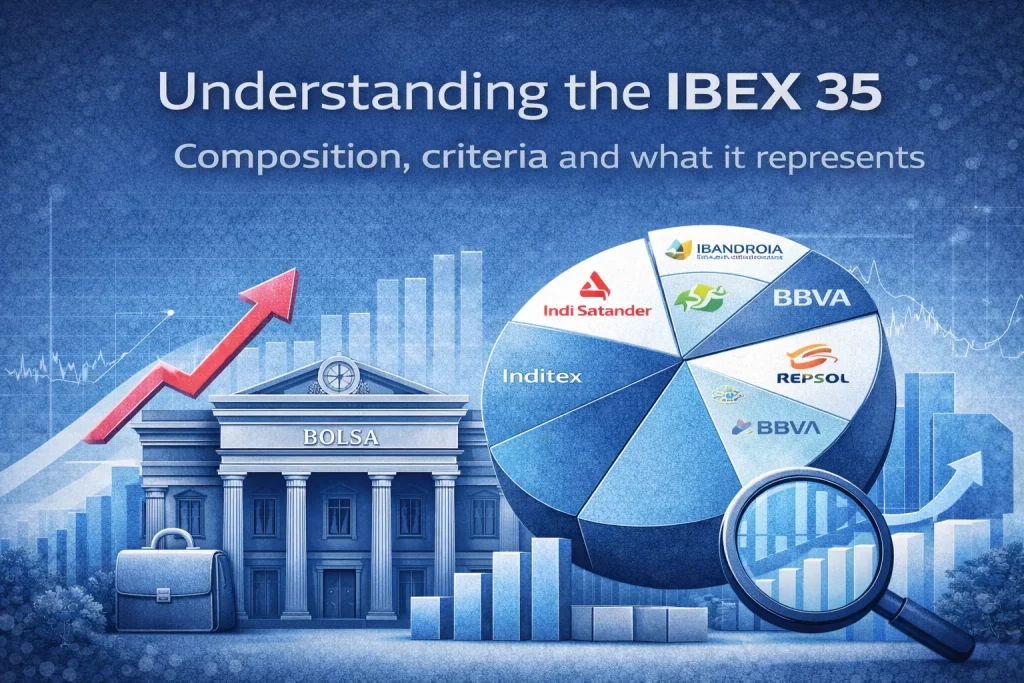
In financial markets, stock indices serve as key benchmarks for understanding the performance of an economy and its leading companies. In Spain, the IBEX 35 is the primary reference.
Beyond its headline value, the index reflects a combination of liquidity, scale, and investor attention—making it a useful, but nuanced, representation of the Spanish equity market.
Representative Companies and Market Capitalization
The IBEX 35 includes some of Spain’s largest and most globally recognized companies. Below is a simplified snapshot of key constituents and their approximate market capitalization:
| Company | Sector | Approx. Market Cap (€bn) |
| Inditex | Retail | 160–190 |
| Banco Santander | Banking | 140–165 |
| Iberdrola | Energy/Utilities | 130–150 |
| BBVA | Banking | 120–135 |
| Repsol | Energy | 25–35 |
This table highlights a key feature of the index: significant concentration in a small number of large-cap companies.
Concentration and Weighting of the Index
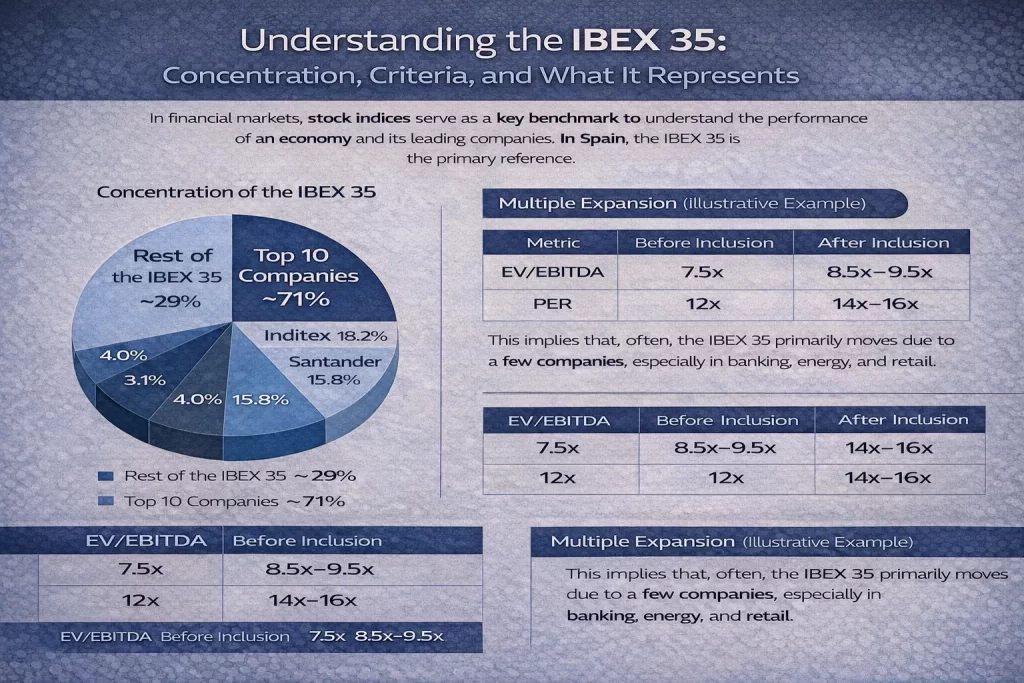
The IBEX 35 is a free-float market capitalization-weighted index. As a result, larger companies exert a disproportionate influence on performance.
In practice:
- The top 3–5 companies represent ~40–50% of the index
- The top 10 companies account for ~70%+
This concentration means that the IBEX 35 is often driven by a relatively small group of companies, particularly in banking, energy, and retail.
Key Sectors Represented in the Index
The index reflects Spain’s corporate landscape, with strong exposure to:
- Banking and financial services
- Energy and utilities
- Infrastructure and construction
- Telecommunications
- Consumer and industrial companies
This sector mix makes the index sensitive to macroeconomic factors such as interest rates and energy prices.
How Companies Are Selected (With Quantitative Criteria)
Inclusion is determined by liquidity and market relevance, reviewed twice per year.
Typical thresholds include:
- Top 35–40 stocks by trading volume over 6 months
- Trading on at least ~33% of sessions
- Minimum ~0.3%–0.5% of total market free float
- Usually €3–5bn+ market cap range
Liquidity remains the decisive factor.
Valuation Impact: Price and Multiples
Inclusion in the IBEX 35 affects not only price, but also valuation multiples.
| Impact Area | Effect |
| Passive demand | Short-term price increase |
| Liquidity | Lower liquidity discount |
| Visibility | Higher analyst coverage |
| Institutional ownership | Increased demand stability |
Multiples Expansion (Illustrative)
| Metric | Pre-Inclusion | Post-Inclusion |
| EV/EBITDA | 7.5x | 8.5x–9.5x |
| P/E | 12x | 14x–16x |
This expansion reflects improved liquidity, visibility, and investor access—not necessarily changes in fundamentals.
Largest and Smallest Companies in the IBEX 35
- Largest: Inditex
- Smallest (typical range): ~€3–5 billion
This dispersion reinforces the importance of weighting in interpreting index movements.
Potential Candidates to Enter the IBEX 35
Companies closest to inclusion are typically those combining sufficient size with improving liquidity.
Common candidates include:
- Fluidra
- Solaria
- Laboratorios Rovi
- Acerinox
However, inclusion ultimately depends more on trading activity than size alone.
What the IBEX 35 Does—and Does Not—Represent
The index reflects:
- Spain’s most liquid listed companies
- Market sentiment and capital flows
But it does not fully capture:
- SMEs
- Private companies
- Full sector diversification
It is therefore a market benchmark, not a complete economic proxy.
Final Thoughts
The IBEX 35 is shaped by liquidity, concentration, and investor behavior.
Understanding:
- how companies enter the index
- how weightings drive performance
- how inclusion affects valuation
provides a much deeper perspective than simply tracking its level.
A Practical Note
For investors and professionals, analyzing the IBEX 35 through the lens of valuation and market structure offers a clear advantage.
Incorporating index dynamics into financial models and investment decisions can significantly improve analytical depth and decision-making quality.