

Introduction
A strong financial model is one of the most important tools a company can develop when preparing to raise capital, evaluate strategic decisions or communicate with investors.
Whether you are a startup founder preparing for a Seed round, an SME planning expansion or an entrepreneur seeking debt financing, investors will expect a clear and credible view of your company’s financial future.
However, many financial models fail for one simple reason: they are built to look impressive instead of being built to support decision-making.
A good investor financial model should not only forecast revenue and profitability. It should explain the economic logic of the business, identify the key operational drivers and demonstrate that management understands both opportunities and risks.
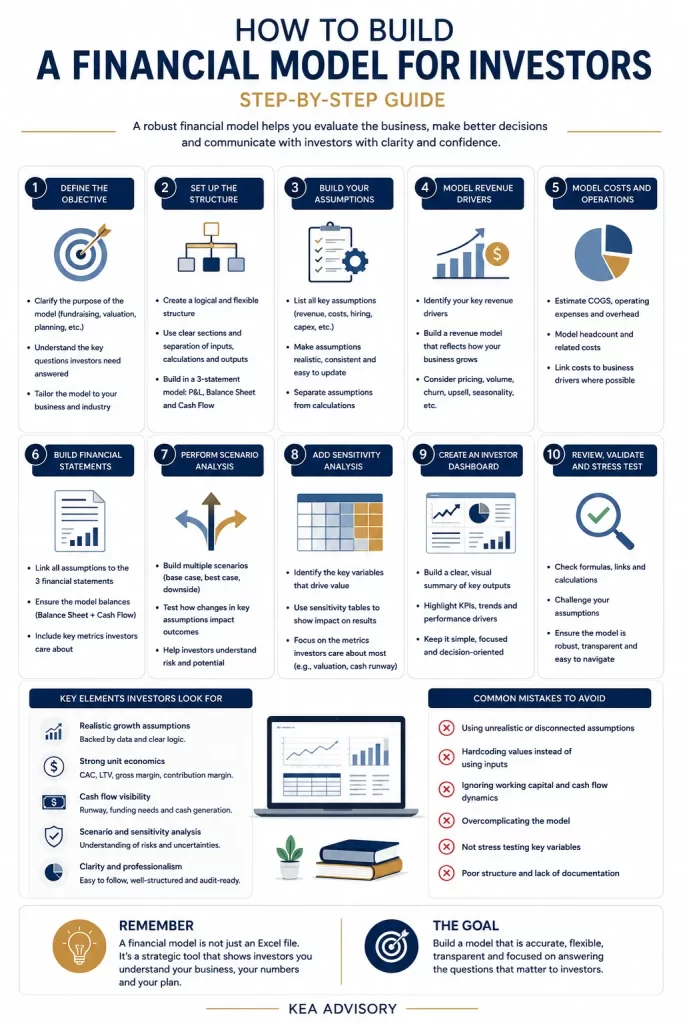
In this article, we explain step-by-step how to build a professional financial model for investors.
What Is an Investor Financial Model?
An investor financial model is a structured representation of a company’s expected financial performance over time.
Typically built in Excel, the model combines:
- Historical financial information
- Operational assumptions
- Revenue forecasts
- Cost structures
- Cash flow projections
- Scenario analysis
- Funding requirements
The purpose is not to predict the future with perfect accuracy.
The objective is to create a logical framework that allows investors and management teams to evaluate:
- Business viability
- Scalability
- Profitability potential
- Capital requirements
- Risks and sensitivities
- Expected returns
A strong financial model helps answer key investor questions such as:
- How does the business generate revenue?
- What drives growth?
- When does the company become profitable?
- How much cash will be required?
- What assumptions are most critical?
- What happens under different scenarios?
Step 1: Define the Objective of the Model
Before building any formulas, the first step is understanding why the model is being created.
Different objectives require different structures and levels of detail.
For example:
| Objective | Focus |
| Fundraising | Growth, scalability and cash runway |
| Bank financing | Debt service capacity and cash generation |
| Internal planning | Budgeting and operational KPIs |
| Acquisition analysis | Synergies and valuation |
| Project finance | Long-term cash flow stability |
One of the most common mistakes is creating an overly complex model that does not align with the actual decision-making process.
In most fundraising situations, investors care more about:
- Assumption quality
- Business logic
- Key operating drivers
- Scalability
- Cash consumption
than about extremely sophisticated spreadsheet structures.
Step 2: Organize Historical Financial Information
Before forecasting the future, it is essential to understand the past.
The model should include at least:
- Historical income statements
- Historical balance sheets
- Historical cash flow statements
- Operational KPIs
Depending on the company stage, historical data may include:
- Monthly information for startups
- Quarterly or annual information for mature businesses
At this stage, analysts should identify:
- Revenue growth trends
- Margin evolution
- Fixed vs variable costs
- Working capital behavior
- Customer acquisition dynamics
- Seasonality patterns
Historical performance is often the best starting point for building realistic assumptions.
Step 3: Identify the Key Business Drivers
Professional financial models are driver-based.
This means forecasts are linked to operational variables rather than arbitrary growth percentages.
For example:
| Business Type | Key Drivers |
| SaaS | Users, churn, ARPU, CAC |
| E-commerce | Traffic, conversion rate, average order value |
| Manufacturing | Production capacity, utilization, pricing |
| Infrastructure | Demand volumes, tariffs, operating costs |
| Consulting | Billable hours, utilization, pricing |
This is one of the biggest differences between professional financial models and basic spreadsheets.
Investors want to understand:
- What operational factors drive growth
- Which assumptions matter most
- Whether assumptions are realistic
- How scalable the business is
A model based only on top-down revenue growth assumptions is rarely convincing.
Step 4: Build Revenue Projections
Revenue forecasting is usually the most sensitive section of the model.
It is also where many founders become overly optimistic.
A credible forecast should combine:
- Market logic
- Historical trends
- Operational capacity
- Commercial assumptions
A common structure includes:
Volume Assumptions
Examples:
- Number of customers
- Units sold
- Active subscriptions
- Transactions processed
- Projects executed
Pricing Assumptions
Examples:
- Average selling price
- Monthly subscription fee
- Pricing increases
- Mix evolution
Growth Assumptions
Growth should reflect:
- Sales capacity
- Market penetration
- Marketing efficiency
- Hiring plans
- Industry dynamics
One of the most common investor concerns is unrealistic revenue acceleration.
For example, projecting revenue growth from €500k to €20 million in three years without explaining operational capacity significantly reduces credibility.
The best models clearly connect growth expectations with real operational drivers.
Step 5: Forecast Operating Costs
Operating expenses should evolve consistently with business activity.
The model should distinguish between:
Variable Costs
Costs that grow with revenue or activity levels.
Examples:
- Cost of goods sold
- Payment processing fees
- Logistics costs
- Sales commissions
Fixed Costs
Costs that remain relatively stable regardless of short-term activity.
Examples:
- Salaries
- Office expenses
- Software subscriptions
- Administrative costs
Investors generally analyze:
- Gross margin evolution
- Operating leverage
- EBITDA margins
- Scalability potential
A strong model demonstrates how the business can improve profitability as revenue grows.
Step 6: Build the Three Financial Statements
Professional investor models typically integrate:
- Income Statement
- Balance Sheet
- Cash Flow Statement
These statements should be fully connected.
For example:
- Net income impacts retained earnings
- Working capital affects cash flow
- Capital expenditures impact depreciation
- Debt impacts interest expenses and financing cash flows
One of the most common modeling mistakes is presenting disconnected financial statements.
Investors and lenders immediately identify inconsistencies such as:
- Balance sheets that do not balance
- Cash positions disconnected from financing flows
- Unrealistic working capital assumptions
An integrated three-statement model significantly improves credibility.
Step 7: Include Working Capital Assumptions
Working capital is often underestimated, especially in fast-growing businesses.
Even profitable companies can face liquidity problems if:
- Customers pay slowly
- Inventory increases rapidly
- Suppliers require shorter payment terms
The model should forecast:
- Accounts receivable days
- Inventory days
- Accounts payable days
This is particularly important for:
- Manufacturing companies
- Retail businesses
- Infrastructure projects
- Companies with long sales cycles
Many fundraising processes fail because companies underestimate future cash needs.
Step 8: Forecast Capital Expenditures and Financing Needs
Growth usually requires investment.
Depending on the business, capital expenditures may include:
- Technology development
- Equipment
- Infrastructure
- Offices
- Production assets
The model should clearly identify:
- Timing of investments
- Funding requirements
- Debt assumptions
- Equity injections
One of the most important outputs for investors is the projected cash runway.
In startup environments, investors want to understand:
- How long current cash will last
- When additional funding may be required
- How efficiently capital is being deployed
Step 9: Perform Scenario and Sensitivity Analysis
No financial forecast is perfectly accurate.
Professional models therefore include multiple scenarios.
Typically:
| Scenario | Description |
| Base Case | Most realistic assumptions |
| Upside Case | Strong commercial execution |
| Downside Case | Slower growth or higher costs |
Sensitivity analysis helps evaluate how changes in key assumptions impact:
- Revenue
- EBITDA
- Cash flow
- Valuation
- Funding requirements
Typical sensitivities include:
- Customer growth
- Pricing
- Gross margins
- Churn
- Capex
- Interest rates
Investors often focus more on downside resilience than upside potential. A company that demonstrates awareness of risks generally inspires more confidence.
Step 10: Keep the Model Simple and Transparent
One of the biggest mistakes in financial modeling is unnecessary complexity.
A good investor model should be:
- Clear
- Structured
- Transparent
- Easy to audit
- Flexible
Best practices include:
- Separate assumptions from calculations
- Use consistent formatting
- Avoid hardcoded formulas
- Minimize circular references
- Include clear tabs and labels
- Use dynamic formulas carefully
A clean and understandable model is usually more valuable than an extremely sophisticated one.
Investors want clarity.
Common Financial Modeling Mistakes
Unrealistic Growth Assumptions
Aggressive growth without operational justification reduces credibility.
Ignoring Cash Flow
Many companies focus only on profitability while underestimating liquidity needs.
Overcomplicated Structures
Highly complex models are difficult to audit and often contain errors.
Lack of Scenario Analysis
Professional investors expect downside analysis.
Disconnected Financial Statements
Integrated financial statements are essential.
No Operational Drivers
Revenue forecasts should connect to business reality.
What Investors Actually Want to See
Many founders assume investors primarily care about large revenue numbers.
In reality, experienced investors often focus more on:
- Assumption quality
- Business understanding
- Scalability logic
- Capital efficiency
- Cash management
- Risk awareness
- Management credibility
A realistic and well-structured model is usually more persuasive than an overly optimistic one.
The objective is not to show a perfect future.
The objective is to demonstrate that management understands the economics of the business.
Final Thoughts
A strong investor financial model is much more than a spreadsheet.
It is a strategic decision-making tool that helps companies:
- Raise capital
- Evaluate growth opportunities
- Understand risks
- Improve planning
- Communicate effectively with investors and lenders
The best financial models combine:
- Technical rigor
- Clear business logic
- Realistic assumptions
- Transparent structure
Companies that invest time in building high-quality financial models are generally better prepared for fundraising processes, strategic discussions and long-term growth.
At KEA Advisory, we support companies, founders and investors in the development of professional financial models, valuation analyses and strategic financial planning tools adapted to each business situation.
Need Support Building an Investor-Ready Financial Model?
Whether you are preparing for a fundraising round, evaluating a strategic investment or improving your internal planning process, a robust financial model can significantly improve decision-making and investor communication.
At KEA Advisory, we support startups, SMEs and investors with:
- Financial modeling
- Business valuation
- Scenario analysis
- Strategic financial planning
- Investor-ready financial projections
If you would like to discuss your project, feel free to contact us.
Frequently Asked Questions (FAQ)
How many years should a financial model forecast?
Most investor financial models project between 3 and 5 years. Infrastructure or project finance models may require longer periods.
Should startups build monthly or annual forecasts?
Early-stage startups typically use monthly projections, especially for cash flow management and fundraising.
What software is commonly used for financial modeling?
Microsoft Excel remains the industry standard for most professional financial modeling processes.
How detailed should a financial model be?
The level of detail should match the decision-making objective. The model should be detailed enough to support analysis but simple enough to remain understandable.
What is the most important part of a financial model?
Usually, the quality and credibility of assumptions are more important than spreadsheet complexity.