

Understanding how much a business is worth is not just a technical exercise—it is a strategic decision. Whether you are raising capital, planning a sale, or simply making better financial decisions, choosing the right valuation methodology can significantly impact outcomes.
In practice, there is no single “correct” valuation method. The right approach depends on the nature of your business, the availability of data, and the purpose of the valuation.
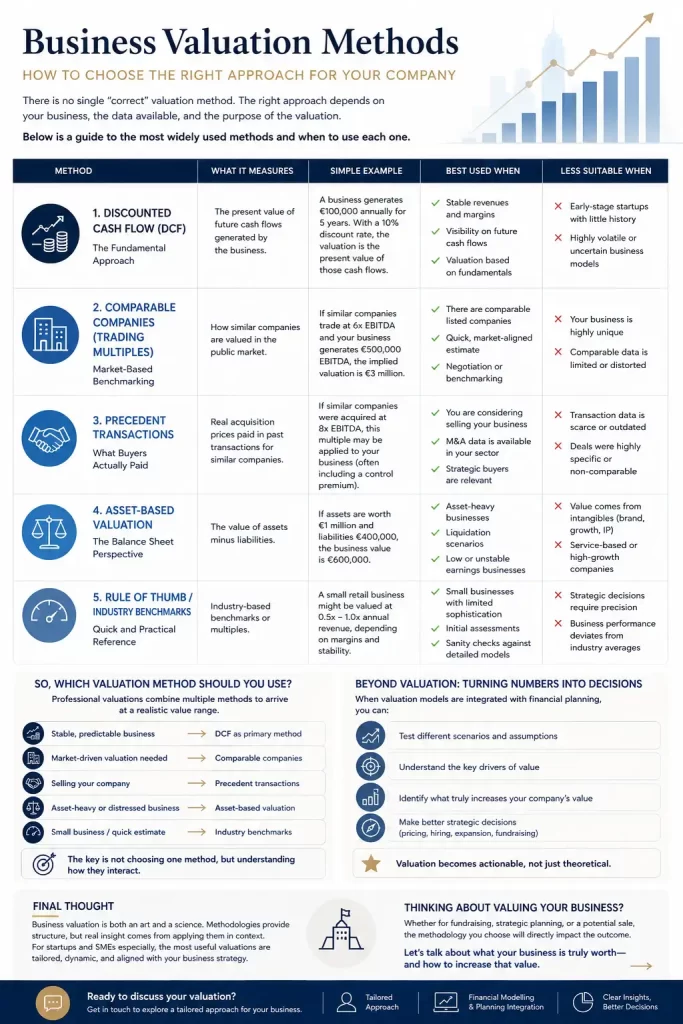
Below is a clear, practical guide to the most widely used business valuation methods—along with when to use each one.
1. Discounted Cash Flow (DCF): The Fundamental Approach
The Discounted Cash Flow (DCF) method values a business based on its ability to generate future cash flows. These cash flows are projected and discounted back to present value using a required rate of return (typically the WACC).
Why it matters:
DCF is the most theoretically sound method because it focuses on intrinsic value—not market noise.
Simple example:
If a business is expected to generate €100,000 annually over the next 5 years, and we apply a 10% discount rate, the valuation reflects the present value of those cash flows—not their nominal sum.
Best used when:
- The business has predictable revenues and margins
- There is visibility on future cash flows
- You want a valuation grounded in fundamentals
Less suitable when:
- Early-stage startups with little financial history
- Highly volatile or uncertain business models
In our experience, DCF becomes significantly more powerful when integrated with financial planning models—allowing scenarios, sensitivities, and strategic decision-making, not just valuation.
2. Comparable Companies (Trading Multiples): Market-Based Benchmarking
This method values a company based on how similar businesses are priced in the market. Common multiples include EV/EBITDA, EV/Revenue, or P/E.
Why it matters:
It reflects what investors are currently willing to pay for similar companies.
Simple example:
If similar companies trade at 6x EBITDA and your business generates €500,000 EBITDA, an implied valuation would be €3 million.
Best used when:
- There are comparable listed companies
- You need a quick, market-aligned estimate
- The valuation is for negotiation or benchmarking
Less suitable when:
- Your business is highly unique
- Comparable data is limited or distorted
This method is often used alongside DCF to “anchor” valuations to market reality.
3. Precedent Transactions: What Buyers Actually Paid
Instead of looking at public markets, this method analyzes past M&A transactions involving similar companies.
Why it matters:
It reflects real acquisition prices, including control premiums and strategic value.
Simple example:
If similar companies were acquired at 8x EBITDA, this multiple may be applied to your business—often higher than trading multiples due to acquisition premiums.
Best used when:
- You are considering selling your business
- M&A data is available in your sector
- Strategic buyers are relevant
Less suitable when:
- Transaction data is scarce or outdated
- Deals were highly specific or non-comparable
For SMEs, this method can be particularly insightful when combined with industry-specific benchmarks.
4. Asset-Based Valuation: The Balance Sheet Perspective
This approach values a company based on the net value of its assets minus liabilities.
Why it matters:
It sets a “floor value” for the business.
Simple example:
If assets are worth €1 million and liabilities €400,000, the business value would be €600,000.
Best used when:
- Asset-heavy businesses (real estate, manufacturing)
- Liquidation scenarios
- Businesses with low or unstable earnings
Less suitable when:
- Value comes from intangibles (brand, growth, IP)
- Service-based or high-growth companies
For many SMEs, this method underestimates real value unless adjusted for intangible drivers.
5. Rule of Thumb / Industry Benchmarks
In many sectors—especially small businesses—valuation is often guided by industry-specific rules of thumb (e.g., a multiple of revenue, EBITDA, or even sector-specific KPIs).
Why it matters:
It provides a quick, practical reference point.
Simple example:
A small retail business might be valued at 0.5x–1.0x annual revenue, depending on margins and stability.
Best used when:
- Small businesses with limited financial sophistication
- Early-stage assessments
- Sanity checks against more detailed models
Less suitable when:
- Strategic decisions require precision
- Business performance deviates from industry averages
These benchmarks should never replace a proper valuation—but they are useful as a starting point.
So, Which Valuation Method Should You Use?
In reality, professional valuations rarely rely on a single method. Instead, they combine approaches to triangulate a realistic value range.
A simplified decision framework:
- Stable, predictable business → DCF as primary method
- Market-driven valuation needed → Comparable companies
- Selling your company → Precedent transactions
- Asset-heavy or distressed → Asset-based valuation
- Small business / quick estimate → Industry benchmarks
The key is not choosing one method—but understanding how they interact.
Beyond Valuation: Turning Numbers into Decisions
A valuation should not be a static number—it should be a decision-making tool.
This is where many generic valuations fall short.
When valuation models are integrated with financial planning:
- You can test growth scenarios
- Understand value drivers
- Identify what actually increases your company’s worth
- Make better strategic decisions (pricing, hiring, expansion, fundraising)
In other words, valuation becomes actionable—not just theoretical.
Final Thoughts
Business valuation is both an art and a science. While methodologies provide structure, real insight comes from applying them in context.
For startups and SMEs especially, the biggest mistake is relying on overly simplistic or generic approaches. The most effective valuations are tailored, dynamic, and aligned with the strategic reality of the business.
Thinking About Valuing Your Business?
If you are considering a valuation—whether for fundraising, strategic planning, or a potential sale—the methodology you choose will directly impact the outcome.
A tailored approach, combining financial modelling with practical business insight, can make a significant difference.
Feel free to reach out if you’d like to explore what your business is really worth—and, more importantly, how to increase that value.