

Introduction
Discounted Cash Flow (DCF) valuation is one of the most widely used valuation methodologies in corporate finance.
From investment banking and private equity to strategic planning and fundraising processes, DCF analysis is frequently used to estimate the intrinsic value of a business based on its future cash generation capacity.
However, despite its popularity, DCF valuation is often misunderstood.
Many founders assume it is a purely theoretical exercise reserved for large corporations or financial institutions. Others build highly complex valuation models without fully understanding the assumptions that truly drive value.
In reality, a well-structured DCF model can be an extremely powerful decision-making tool for startups, SMEs and investors.
A robust DCF valuation helps companies:
- Understand business value drivers
- Evaluate investment opportunities
- Support fundraising discussions
- Analyze strategic scenarios
- Improve financial planning
- Assess long-term profitability
In this article, we explain how DCF valuation works, the key assumptions behind the methodology and the most common mistakes companies make when building valuation models.
What Is DCF Valuation?
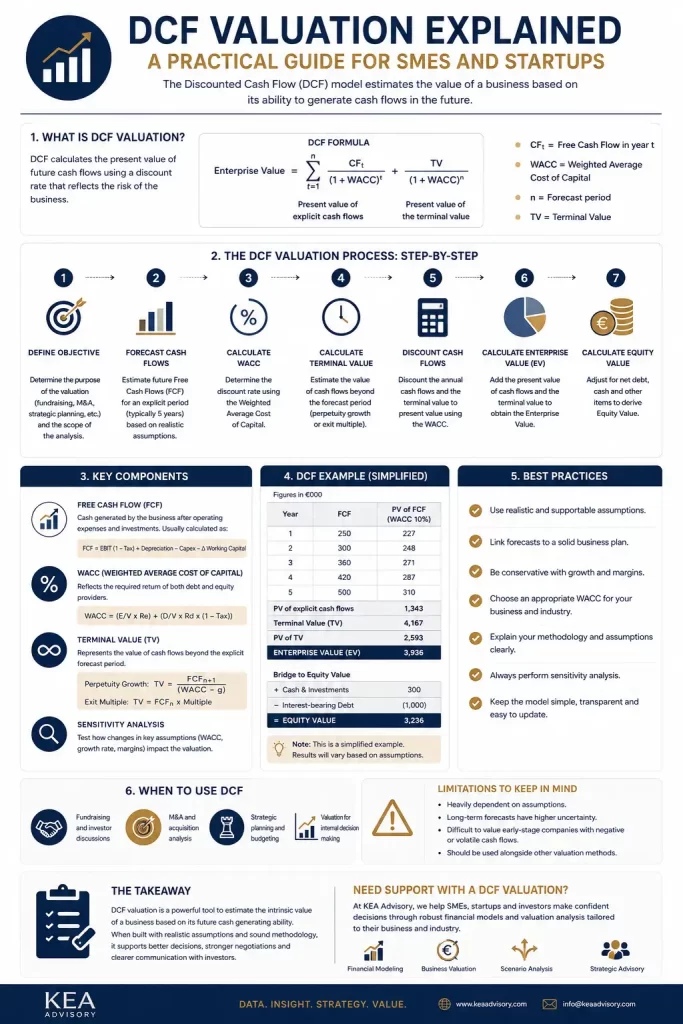
Discounted Cash Flow valuation estimates the value of a business based on the present value of its expected future cash flows.
The core principle behind DCF is relatively simple:
A company is worth the cash it can generate in the future, adjusted for the risk and timing of those cash flows.
Unlike market multiples, which rely on comparable companies or transactions, DCF valuation focuses on the company’s own economic fundamentals.
This makes DCF particularly useful when:
- Comparable companies are limited
- Businesses have unique characteristics
- Long-term cash generation is critical
- Strategic decisions require intrinsic valuation analysis
The methodology is widely used across:
- Corporate finance
- M&A transactions
- Private equity
- Venture capital
- Infrastructure investments
- Strategic planning
The Core Logic Behind DCF Valuation
DCF valuation is based on three main components:
- Forecast future cash flows
- Determine the appropriate discount rate
- Calculate the present value of those cash flows
The higher the expected future cash flows, the higher the valuation.
The higher the risk, the higher the discount rate and the lower the present value.
Step 1: Forecast Revenue Growth
The starting point of most DCF models is projecting future revenue.
This is also one of the most sensitive parts of the analysis.
A credible revenue forecast should combine:
- Historical performance
- Market dynamics
- Operational capacity
- Pricing assumptions
- Commercial strategy
- Industry trends
One of the most common valuation mistakes is using unrealistic growth assumptions without operational justification.
For example, projecting exponential revenue growth without considering:
- Hiring capacity
- Customer acquisition costs
- Competitive pressure
- Production constraints
- Market size
can significantly distort the valuation.
For startups and SMEs, investors generally value realistic and coherent assumptions more than aggressive projections.
Step 2: Estimate Operating Margins
Once revenue has been projected, the next step is estimating operating profitability.
This typically includes:
- Gross margins
- Operating expenses
- EBITDA margins
- Taxes
- Capital expenditures
- Working capital requirements
The objective is to understand how efficiently the business converts revenue into cash flow.
Investors usually pay close attention to:
- Margin scalability
- Operating leverage
- Cost structure stability
- Long-term profitability trends
A strong DCF model clearly explains how margins evolve over time.
For example:
- SaaS businesses may improve margins through scale
- Manufacturing companies may face higher operational intensity
- Infrastructure assets may generate stable long-term margins
The valuation should reflect the actual economics of the business model.
Step 3: Calculate Free Cash Flow
DCF valuation relies on Free Cash Flow (FCF).
Free Cash Flow represents the cash generated by the business after operating costs and required investments.
Free Cash Flow is particularly important because it reflects the cash potentially available to:
- Shareholders
- Lenders
- Investors
Many early-stage businesses generate accounting profits while still consuming large amounts of cash.
This is why understanding working capital, capex and reinvestment requirements is critical in valuation analysis.
Step 4: Determine the Discount Rate (WACC)
The discount rate reflects the risk associated with future cash flows.
In most DCF models, the discount rate is calculated using the Weighted Average Cost of Capital (WACC).
The higher the perceived business risk, the higher the discount rate.
For startups and SMEs, determining the correct discount rate can be particularly challenging because:
- Historical data may be limited
- Cash flows are less predictable
- Financing structures evolve rapidly
- Market comparables may not be fully reliable
In practice, investors often apply higher discount rates to early-stage companies due to execution and market risks.
Step 5: Estimate the Terminal Value
Most DCF valuations include two periods:
- Explicit forecast period
- Terminal period
The terminal value captures the value of the business beyond the forecast horizon.
In many DCF models, terminal value represents a substantial percentage of the total valuation.
One of the biggest DCF risks is using unrealistic terminal assumptions.
For example:
- Excessively high perpetual growth rates
- Unrealistic margin expansion
- Inconsistent reinvestment assumptions
can artificially inflate valuations.
Long-term growth assumptions should generally remain conservative and aligned with economic reality.
Step 6: Discount Future Cash Flows to Present Value
Once future cash flows and terminal value are estimated, they are discounted back to present value.
The logic behind discounting is simple:
Cash received in the future is worth less than cash received today because of:
- Risk
- Inflation
- Opportunity cost
- Uncertainty
The present value of future cash flows represents the estimated enterprise value of the business.
From there, analysts typically adjust for:
- Debt
- Cash balances
- Minority interests
- Non-operating assets
in order to estimate equity value.
Why DCF Valuation Matters for SMEs and Startups
Many SMEs and startups assume DCF valuation is only relevant for large corporations.
In reality, DCF analysis can provide valuable insights even for early-stage businesses.
For example, DCF models help management teams:
- Understand key value drivers
- Evaluate hiring decisions
- Analyze growth investments
- Assess financing needs
- Improve strategic planning
- Prepare investor discussions
A DCF model forces companies to think carefully about:
- Scalability
- Profitability
- Cash generation
- Capital efficiency
- Long-term sustainability
Even when valuations are uncertain, the process itself often improves strategic decision-making.
Common DCF Valuation Mistakes
Unrealistic Revenue Growth
Aggressive growth assumptions without operational support reduce credibility.
Ignoring Working Capital
Many businesses underestimate the cash required to sustain growth.
Incorrect Discount Rates
Using inappropriate WACC assumptions can significantly distort valuations.
Excessively Optimistic Terminal Values
Terminal assumptions often drive a large portion of total valuation.
Overcomplicated Models
Complex models are harder to audit and frequently contain errors.
Lack of Scenario Analysis
Professional valuations should include:
- Base case
- Upside case
- Downside case
Sensitivity analysis is essential.
DCF vs Market Multiples
DCF valuation and market multiples are often used together.
However, they serve different purposes.
| Method | Focus |
| DCF Valuation | Intrinsic value based on future cash flows |
| Market Multiples | Relative value based on comparable companies |
Market multiples are generally:
- Faster
- Simpler
- Easier to benchmark
DCF analysis is generally:
- More detailed
- More assumption-driven
- More sensitive to long-term forecasts
In practice, professional valuation processes often combine:
- DCF analysis
- Trading comparables
- Transaction comparables
- Strategic analysis
rather than relying on a single methodology.
What Investors Actually Look for in a DCF Model
Investors rarely expect a DCF model to predict the future perfectly.
Instead, they typically focus on:
- Assumption quality
- Internal consistency
- Understanding of business drivers
- Scalability logic
- Cash flow visibility
- Risk awareness
- Management credibility
A realistic and transparent valuation model is generally more persuasive than an overly optimistic one.
The objective is not to maximize valuation artificially.
The objective is to demonstrate a deep understanding of how the business creates value over time.
Final Thoughts
DCF valuation remains one of the most powerful tools in corporate finance.
When built correctly, a DCF model helps companies and investors:
- Understand intrinsic business value
- Improve strategic decision-making
- Evaluate investment opportunities
- Assess financing requirements
- Analyze long-term profitability
The quality of a DCF valuation depends less on spreadsheet complexity and more on:
- Realistic assumptions
- Strong business understanding
- Logical structure
- Transparent methodology
For startups and SMEs, a well-structured DCF model can significantly improve investor communication, fundraising preparation and strategic planning.
At KEA Advisory, we support companies, founders and investors with:
- DCF valuation models
- Business valuation services
- Financial modeling
- Scenario analysis
- Strategic financial planning
adapted to each business situation and investment objective.
Need Support with a DCF Valuation or Business Valuation?
Whether you are preparing for a fundraising process, evaluating an acquisition opportunity or improving your strategic financial planning, a robust valuation model can significantly improve decision-making and investor communication.
At KEA Advisory, we support startups, SMEs and investors with:
- DCF valuation models
- Business valuation analyses
- Financial modeling
- Scenario and sensitivity analysis
- Investor-ready financial projections
If you would like to discuss your project, feel free to contact us.
Frequently Asked Questions (FAQ)
What is the main purpose of DCF valuation?
DCF valuation estimates the intrinsic value of a business based on its future cash generation capacity.
Is DCF valuation suitable for startups?
Yes, although early-stage startups require more careful assumptions due to uncertainty and limited historical data.
What is the most sensitive assumption in a DCF model?
Usually, revenue growth, discount rate and terminal value assumptions have the largest impact on valuation.
What discount rate should startups use?
There is no universal answer. Early-stage businesses generally require higher discount rates due to greater risk and uncertainty.
Is DCF better than valuation multiples?
Both methods have advantages and limitations. Professional valuations often combine DCF analysis with market multiples and strategic analysis.