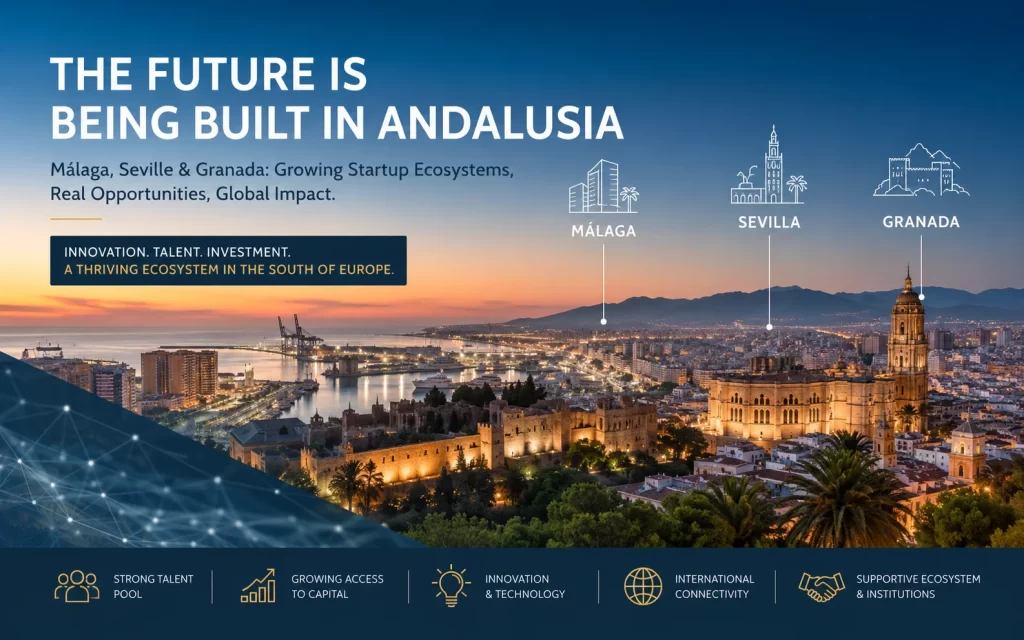
Over the last few years, Andalusia has quietly become one of the most dynamic entrepreneurial regions in Southern Europe. While Madrid and Barcelona continue to dominate Spain’s startup landscape, cities such as Málaga, Seville and Granada are increasingly attracting founders, investors, international talent and technology companies looking for growth opportunities at lower operating costs and with strong institutional support.
Among these cities, Málaga has emerged as the leading innovation hub in Southern Spain. Its combination of international connectivity, quality of life, growing technology infrastructure and public-private collaboration has transformed the city into an attractive destination for startups, scaleups and foreign companies entering the Spanish market.
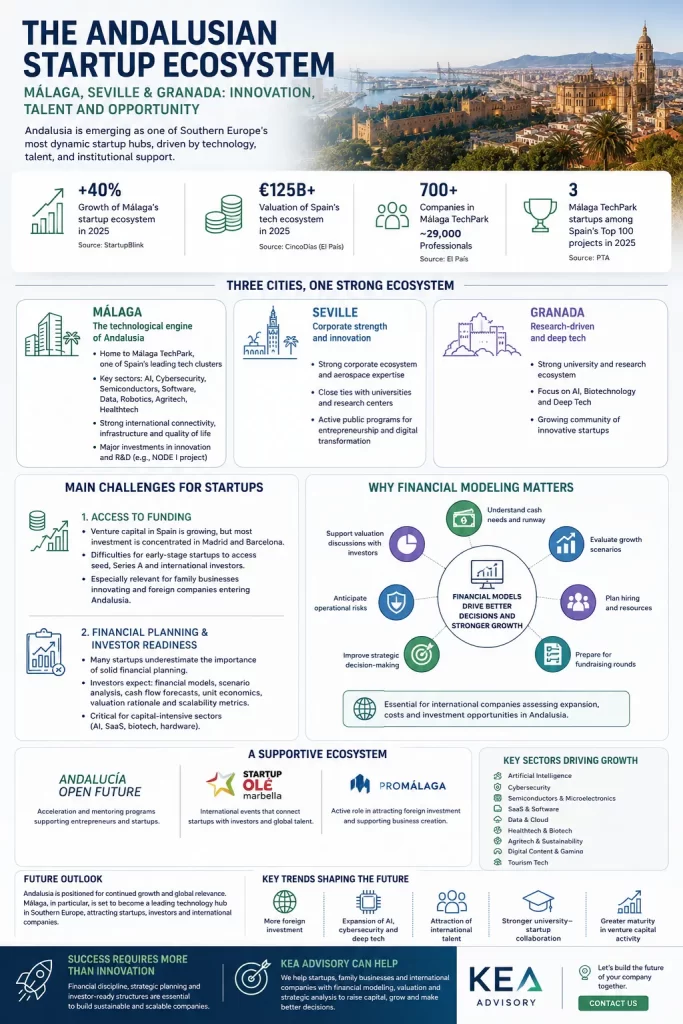
According to StartupBlink, Málaga’s startup ecosystem grew by nearly 40% in 2025, positioning the city among the fastest-growing emerging ecosystems in Spain. (startupblink.com)
At the same time, Spain’s broader technology ecosystem surpassed €125 billion in value in 2025, driven largely by the rapid expansion of artificial intelligence and deep tech companies. (Cinco Días)
Málaga: The Technological Engine of Andalusia
Much of Málaga’s growth revolves around Málaga TechPark, formerly known as Parque Tecnológico de Andalucía (PTA). The park has become one of Spain’s most important technology clusters, hosting more than 700 companies and close to 29,000 professionals. (El País)
The ecosystem combines startups, multinational corporations, research centers and universities in sectors including:
- Artificial Intelligence
- Cybersecurity
- Semiconductor technology
- Software development
- Data engineering
- Robotics
- Agritech
- Healthtech
Several international companies have expanded operations in Málaga in recent years, reinforcing the city’s reputation as a European technology destination. At the same time, local startups are increasingly gaining national recognition. In 2025, three startups from Málaga TechPark were included among Spain’s top 100 startup projects. (PTA)
The city is also benefiting from growing investment in infrastructure and innovation. Recent projects such as NODE I and the expansion of research facilities are expected to strengthen Málaga’s position in advanced technologies and microelectronics. (Cadena SER)
Seville and Granada: Complementary Innovation Ecosystems
Although Málaga leads the region in visibility and international attraction, Seville and Granada also play important roles within Andalusia’s startup ecosystem.
Seville has traditionally benefited from strong corporate activity, aerospace expertise and institutional support. The city hosts innovation initiatives connected to large corporations, universities and public programs focused on entrepreneurship and digital transformation.
Meanwhile, Granada has developed a strong reputation in research-driven sectors thanks to its university ecosystem. Areas such as artificial intelligence, biotechnology and deep tech are increasingly relevant in the city’s entrepreneurial landscape.
Together, Málaga, Seville and Granada are creating a more diversified regional ecosystem capable of attracting both domestic and international entrepreneurs.
The Main Challenges Facing Andalusian Startups
Despite the positive momentum, startups in Andalusia still face several structural challenges.
Access to Funding
One of the main difficulties for early-stage companies remains access to capital. While venture capital activity in Spain has increased significantly in recent years, most investment continues to concentrate in Madrid and Barcelona. (Cinco Días)
As a result, many founders in Andalusia struggle to secure seed funding, Series A rounds or international investors.
This challenge becomes even more significant for family-owned businesses transitioning toward innovation-driven models or for foreign companies entering the Andalusian market without local financial visibility.
Financial Planning and Investor Readiness
Many startups focus heavily on product development and commercial growth while underestimating the importance of robust financial planning.
In practice, investors increasingly expect companies to present:
- Reliable financial models
- Scenario analysis
- Cash flow forecasts
- Unit economics
- Valuation rationale
- Fundraising assumptions
- Scalability metrics
Without these tools, even startups with strong products may struggle to communicate their business potential effectively.
This is particularly important in capital-intensive sectors such as AI, SaaS, biotech or hardware, where runway management and long-term forecasting become critical.
Why Financial Modeling Has Become Essential
As startup ecosystems mature, financial sophistication becomes increasingly important.
Today, financial modeling is no longer just a fundraising exercise. It has become a strategic management tool.
Well-structured financial models help founders:
- Understand cash needs and runway
- Evaluate different growth scenarios
- Analyze hiring capacity
- Prepare fundraising rounds
- Improve strategic decision-making
- Anticipate operational risks
- Support valuation discussions with investors
For international companies entering Andalusia, financial planning is equally important when evaluating market expansion, operational costs and local investment opportunities.
In many cases, startups with strong operational performance still fail because they lack financial visibility or scalable planning structures.
Professional financial advisory services can help bridge this gap between entrepreneurial vision and investor expectations.
Accelerators, Institutions and Ecosystem Support
One of Andalusia’s strengths is the growing collaboration between public institutions, accelerators and private companies.
Programs such as Andalucía Open Future continue supporting entrepreneurs through acceleration initiatives and mentoring programs. (Promalaga)
At the same time, events such as Startup OLÉ Marbella are increasing international visibility for the region’s entrepreneurial ecosystem and facilitating connections between startups and investors. (Startup OLE Marbella)
Organizations such as Promálaga are also playing an active role in attracting foreign investment and supporting new business creation in the region. (Promalaga)
This combination of institutional support, international exposure and improving infrastructure is helping Andalusia position itself as a credible alternative to Spain’s larger startup hubs.
Future Outlook: A Growing Opportunity for Startups and Investors
The outlook for the Andalusian startup ecosystem remains highly positive.
Several trends are likely to shape the next phase of growth:
- Expansion of AI and cybersecurity companies
- Increased foreign investment
- Growth in semiconductor and microelectronics projects
- Rising international talent attraction
- Stronger collaboration between universities and startups
- Greater maturity in venture capital activity
Málaga, in particular, appears well positioned to continue consolidating its role as a Southern European technology hub.
Its ability to combine quality of life, international accessibility, lower operating costs and technological infrastructure creates an attractive environment not only for startups, but also for investors and international businesses looking for strategic expansion opportunities in Spain.
Final Thoughts
Andalusia is no longer an emerging ecosystem operating in the shadow of Madrid or Barcelona. It is becoming an increasingly relevant innovation region in its own right.
However, as competition intensifies and investors become more selective, startups must complement innovation with financial discipline, strategic planning and investor-ready business structures.
For founders, family-owned businesses and international companies entering the Andalusian market, robust financial modeling and valuation analysis are becoming essential tools for sustainable growth.
At KEA Advisory, we help startups and growing companies build financial models, valuation frameworks and strategic analyses that support fundraising, expansion and long-term decision-making in fast-changing markets.