
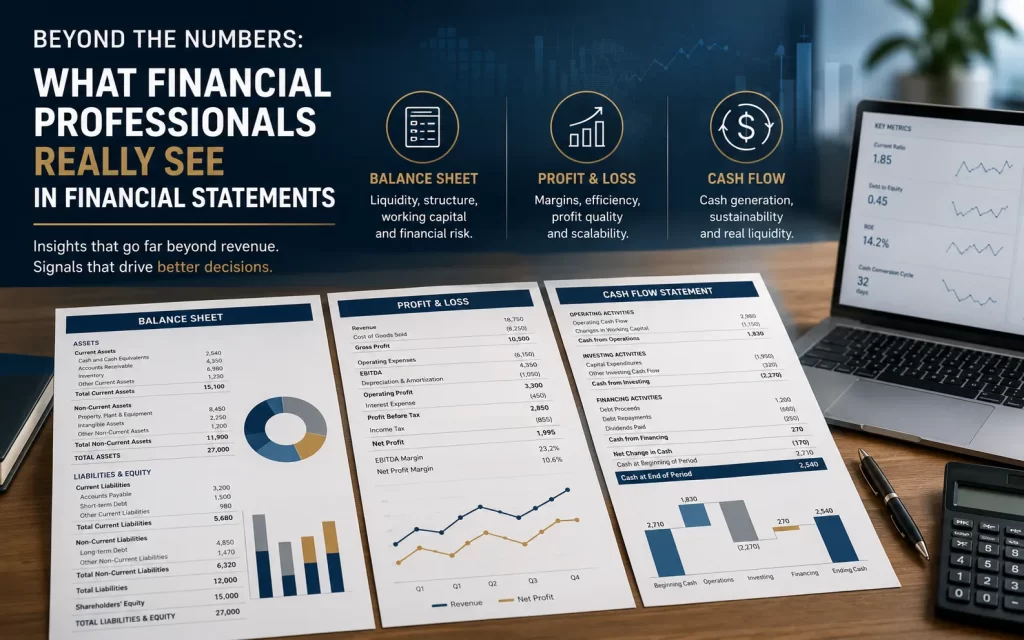
Many business owners look at financial statements and focus on a few obvious figures:
- revenue growth,
- profit,
- cash in the bank,
- or debt levels.
But experienced financial professionals rarely analyze companies that way.
For an analyst, investor or financial advisor, financial statements are not simply accounting documents. They are a reflection of how a business truly operates beneath the surface.
Two companies may report similar revenue growth and profitability while having completely different financial quality, risk exposure and long-term sustainability.
That difference often becomes visible only through deeper financial analysis.
This is especially important today. In an environment of higher interest rates, tighter financing conditions and more selective investors, understanding the hidden signals inside financial statements has become far more valuable than simply looking at top-line growth.
At KEA Advisory, much of our work involves helping founders, investors and companies interpret financial information beyond the obvious numbers.
Because financial analysis is rarely about isolated metrics. It is about identifying patterns, relationships, inconsistencies and trends that reveal what is really happening inside a business.
Financial Analysis Is About Connecting Signals
One of the biggest misconceptions about financial analysis is believing that professionals focus mainly on formulas and ratios.
In reality, experienced analysts spend far more time asking questions such as:
- Why is cash flow deteriorating while profits improve?
- Why are receivables growing faster than revenue?
- Why is inventory increasing despite slowing sales?
- Why does EBITDA look strong while liquidity weakens?
- Why does growth require increasingly more capital?
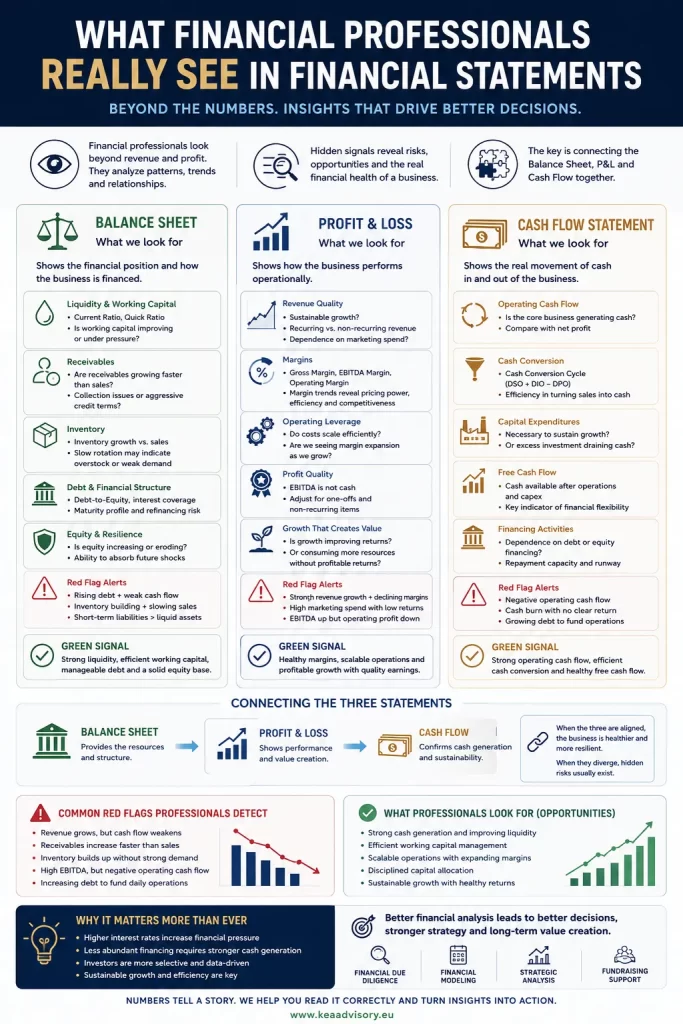
The real value of financial analysis comes from understanding how the three financial statements interact:
- the Balance Sheet,
- the Profit & Loss Statement,
- and the Cash Flow Statement.
Individually, each one provides information.
Together, they reveal the financial reality of a company.
Balance Sheet: The Hidden Story Behind Financial Position
To non-financial professionals, a balance sheet often appears static and difficult to interpret.
For financial analysts, however, it is one of the most revealing documents in the entire business.
A balance sheet does not simply show what a company owns and owes. It shows:
- how growth is being financed,
- how operationally efficient the company is,
- how much financial pressure exists,
- and how resilient the business may be under stress.
Liquidity Is More Important Than Many Companies Realize
One of the first things analysts evaluate is liquidity.
A company may appear profitable while facing hidden short-term pressure if:
- receivables are growing too quickly,
- inventory is consuming cash,
- or short-term liabilities are increasing faster than liquid assets.
This is why metrics such as:
- Current Ratio,
- Quick Ratio,
- and working capital trends
remain highly important.
But professionals rarely stop at the ratios themselves.
They analyze why liquidity is evolving in a certain direction.
For example, rapidly increasing receivables may indicate:
- collection issues,
- overly aggressive sales policies,
- customer concentration risk,
- or hidden pressure to maintain growth.
In some cases, businesses unintentionally become financiers of their own customers.
Inventory Often Reveals Operational Problems Before the P&L Does
Inventory analysis is another area where experienced analysts focus heavily.
Growing inventory can sometimes indicate:
- poor demand forecasting,
- operational inefficiencies,
- slowing product rotation,
- purchasing misalignment,
- or future margin pressure.
This is especially relevant in:
- retail,
- consumer goods,
- manufacturing,
- and product-based startups.
A business may continue reporting revenue growth while inventory quietly absorbs increasing amounts of cash in the background.
In many cases, financial pressure becomes visible in the balance sheet long before it appears in profitability metrics.
Debt Is Not Necessarily the Problem
Many business owners focus primarily on how much debt a company has.
Professionals usually focus more on:
- debt structure,
- repayment capacity,
- maturity profile,
- interest burden,
- and financing dependency.
Two companies with identical leverage may have completely different financial risk profiles depending on:
- cash generation,
- operating stability,
- and refinancing needs.
This has become even more important in today’s higher interest rate environment, where refinancing risk and financing costs play a much bigger role than they did a few years ago.
Profit & Loss Statement: Revenue Alone Never Tells the Full Story
Revenue growth attracts attention.
But professional analysts know that revenue alone rarely explains the quality of a business.
In many situations, strong sales growth can actually hide deteriorating economics underneath.
The Quality of Revenue Matters
Financial professionals typically analyze:
- how sustainable revenue growth is,
- whether it depends excessively on marketing spend,
- how recurring the revenue base is,
- and whether growth is generating operational leverage.
For example, two companies may both grow revenue by 30%.
However:
- one may improve margins and cash generation,
- while the other may require disproportionately higher marketing, operational and financing costs just to maintain growth.
The numbers may look similar at first glance.
The underlying business quality may be completely different.
Margin Analysis Often Reveals Strategic Problems
Margins tell a much deeper story than many companies realize.
Professionals closely monitor:
- Gross Margin,
- EBITDA Margin,
- Operating Margin,
- and contribution margins.
Not only the absolute figures, but also how they evolve over time.
Margin deterioration may indicate:
- pricing pressure,
- operational inefficiencies,
- rising customer acquisition costs,
- supply chain problems,
- or declining competitive strength.
Meanwhile, improving margins can sometimes reveal:
- scalability,
- stronger operational discipline,
- pricing power,
- or increasing efficiency.
One of the key goals of financial analysis is distinguishing between:
- profitable growth,
- and growth that destroys value.
EBITDA Is Useful — But Often Misunderstood
Many companies and investors focus heavily on EBITDA.
While EBITDA can be useful for comparing operational performance, professionals rarely analyze it in isolation.
Strong EBITDA does not necessarily mean:
- strong cash generation,
- low financial risk,
- or operational sustainability.
A company may report positive EBITDA while simultaneously:
- consuming large amounts of cash,
- accumulating inventory,
- increasing receivables,
- or depending heavily on external financing.
This is why analysts always connect profitability with balance sheet dynamics and cash flow performance.
Cash Flow Statement: Where Financial Reality Usually Appears
If there is one statement that financial professionals often prioritize above all others, it is the Cash Flow Statement.
Because cash flow is difficult to manipulate over long periods of time.
A business can temporarily improve accounting profitability.
It is much harder to hide weak cash generation indefinitely.
Why Profitable Companies Sometimes Run Out of Cash
One of the most common situations analysts encounter is companies that appear profitable while facing growing liquidity pressure.
This usually happens because accounting profit and cash generation are not the same thing.
Cash flow analysis helps reveal:
- working capital pressure,
- operational sustainability,
- financing dependency,
- and real liquidity generation.
For example:
- rapidly growing receivables reduce cash,
- inventory expansion consumes liquidity,
- debt repayments create pressure,
- and capital expenditures may absorb significant resources.
A company can report strong net income while simultaneously weakening financially.
This is one of the reasons experienced investors focus heavily on:
- Operating Cash Flow,
- Free Cash Flow,
- and cash conversion efficiency.
Cash Burn Is Not Always Negative — But It Must Be Understood
For startups and high-growth businesses, negative cash flow is not automatically a problem.
The critical question is:
Why is the company consuming cash, and is that consumption sustainable?
Professionals evaluate:
- burn rate,
- runway,
- scalability,
- financing needs,
- and expected return on invested capital.
A company burning cash to finance scalable growth opportunities may represent a strong investment case.
A company burning cash due to operational inefficiency is a completely different situation.
The numbers themselves rarely provide the full answer.
Interpretation matters.
The Most Important Insight: Financial Statements Must Be Connected
One of the biggest differences between non-professional and professional analysis is that experienced analysts rarely evaluate financial statements independently.
They look for consistency across all three statements.
For example:
- revenue growth should eventually support cash generation,
- inventory increases should align with operational expansion,
- debt growth should have a strategic explanation,
- and profitability should translate into stronger equity over time.
When inconsistencies appear, analysts investigate further.
Very often, the most important financial risks are not found in a single metric.
They emerge from the relationships between multiple indicators.
This is why professional financial analysis goes far beyond simply reading financial statements.
It involves interpreting how the business truly functions operationally, strategically and financially.
Why This Matters More Than Ever Today
In recent years, financial discipline has become increasingly important.
Investors are more selective.
Financing is more expensive.
Liquidity matters more.
And sustainable growth is receiving far greater attention than growth at any cost.
As a result, businesses increasingly need:
- stronger financial visibility,
- better forecasting,
- more sophisticated modeling,
- and deeper strategic analysis.
The companies that understand their financial reality early tend to make better decisions faster.
Final Thoughts
Financial statements always tell a story.
The question is whether someone knows how to read it properly.
Experienced financial professionals look beyond revenue, profit and headline metrics. They analyze:
- hidden risks,
- operational inefficiencies,
- liquidity pressure,
- scalability,
- financing sustainability,
- and long-term value creation.
Often, the most important signals are not obvious at first glance.
At KEA Advisory, we help companies, founders and investors interpret financial information through strategic analysis, financial modeling and financial due diligence processes that support better decision-making, fundraising and long-term growth.