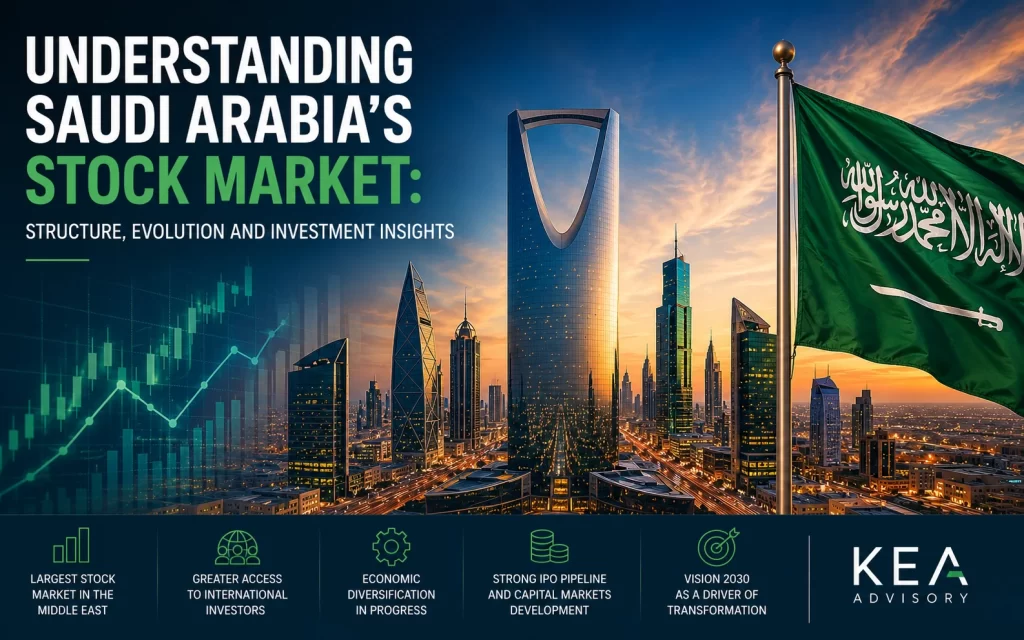
Over the last decade, Saudi Arabia has undergone one of the most ambitious economic transformation programs in the world.
Traditionally associated with oil production and state-driven economic development, the Kingdom has increasingly positioned itself as a global investment destination through regulatory reform, capital market development and economic diversification.
At the center of this transformation sits the Saudi stock market.
Today, Saudi Arabia operates the largest capital market in the Middle East and one of the largest globally by market capitalization. But understanding the Saudi market requires looking beyond headline figures.
Its structure reveals a market that is becoming increasingly diversified and internationally accessible while still maintaining significant concentration around strategic sectors and state-linked companies.
For investors, business leaders and financial professionals, understanding these dynamics matters not only from an investment perspective, but also for financial modeling, investment research and long-term strategic analysis.
Understanding Saudi Arabia’s Stock Market
Saudi Arabia’s stock exchange operates under the name Saudi Exchange (Tadawul).
Its main benchmark is the Tadawul All Share Index (TASI), which tracks listed companies on the Main Market and serves as the country’s primary equity benchmark.
Today, Saudi Arabia’s market represents one of the most significant pools of capital across emerging markets.
Approximate market characteristics include:
- Market capitalization of approximately SAR 9.9 trillion (USD ~2.65 trillion)
- The largest stock market in the Middle East
- Approximately 270 listed companies in the Main Market
- Additional listed securities through REITs, ETFs, debt instruments and growth markets
- Foreign ownership exceeding SAR 460 billion
These figures demonstrate how far Saudi Arabia has evolved from a relatively closed domestic exchange toward becoming an internationally relevant capital market.
However, scale alone does not explain the market.
The more interesting question is how Saudi Arabia achieved this transformation.
How Vision 2030 Changed the Saudi Capital Market
To understand today’s market, it is impossible to ignore Saudi Vision 2030.
Launched in 2016, Vision 2030 seeks to reduce dependency on hydrocarbons while increasing private-sector participation, foreign investment and economic diversification.
Capital markets became one of the key mechanisms supporting this transition.
Several developments have reshaped the market.
Expansion of IPO Activity
One of the clearest indicators of capital market development has been the acceleration of IPO activity.
Saudi Arabia has become one of the most active IPO markets in the Gulf region by number of transactions.
Recent activity illustrates this evolution:
- 2021: approximately SAR 17 billion raised
- 2022: around 17 Main Market IPOs raising approximately SAR 37 billion
- 2023: activity slowed alongside global markets but remained structurally strong
- 2024: approximately 42 listings across Main Market and Nomu, raising around USD 4 billion
- 2025: approximately 37 total listings, generating approximately SAR 14–15 billion
What makes this trend particularly interesting is that IPO activity is increasingly expanding beyond traditional sectors.
Examples include:
- Rasan Information Technology → fintech and insurtech
- Miahona → water infrastructure
- Fourth Milling Company → industrial food processing
- Almoosa Health → healthcare
- Modern Mills Company → consumer and industrial sectors
This shift reflects one of the central ideas behind Vision 2030: using public markets to support the expansion of sectors that historically played a smaller role in the Saudi economy.
Development of the SME Market
Saudi Arabia strengthened Nomu, its parallel market designed specifically for growth companies and SMEs.
Nomu offers:
- lower listing requirements,
- earlier access to public capital,
- improved liquidity,
- and stronger exit opportunities for founders and investors.
This market has become increasingly relevant for:
- family-owned businesses,
- technology companies,
- industrial SMEs,
- and growth-stage businesses.
From a strategic perspective, Nomu also serves another function: helping diversify future market composition away from concentration in large state-linked entities.
Increased Private-Sector Participation
Historically, Saudi Arabia’s economy relied heavily on state-owned entities and government-led investment.
Over time, reforms encouraged:
- private ownership,
- privatization initiatives,
- public listings,
- and broader investor participation.
Examples include:
- privatization of milling companies,
- infrastructure projects,
- utilities,
- logistics initiatives,
- and selected healthcare investments.
This gradual transfer of economic activity toward private ownership is becoming increasingly visible within public markets.
Inclusion in Major International Indices
Saudi Arabia’s inclusion into:
- MSCI Emerging Markets
- FTSE Emerging Markets
marked a major milestone.
These additions accelerated:
- international visibility,
- institutional participation,
- passive capital inflows,
- and overall market liquidity.
This also forced improvements in:
- governance,
- reporting standards,
- settlement systems,
- and accessibility.
Progressive Opening to International Capital
Access for international investors has changed significantly.
Foreign investors progressively gained:
- direct equity access,
- simplified participation rules,
- broader ownership rights,
- and improved market accessibility.
This transition represents one of the most important structural changes in Saudi Arabia’s financial history.
Historically, capital entered the Kingdom through relatively controlled channels.
Today, Saudi Arabia increasingly resembles mature international capital markets in accessibility and openness.
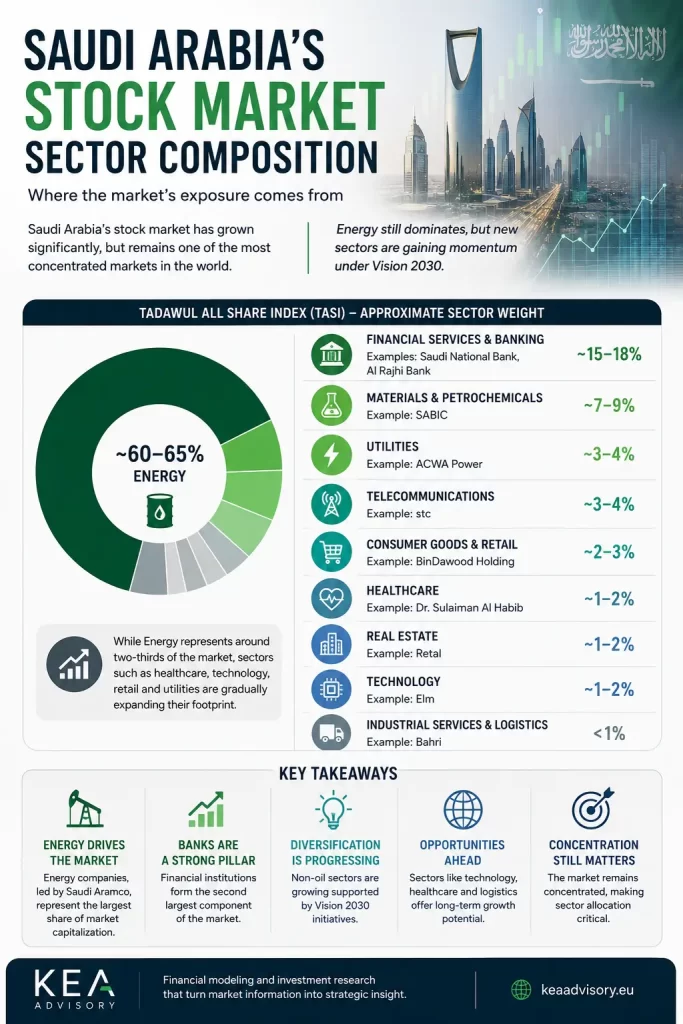
Sector Composition: Where Saudi Arabia’s Market Exposure Really Comes From
Although diversification has advanced considerably, Saudi Arabia remains one of the most concentrated equity markets globally.
Approximate sector exposure within TASI is shown below.
| Sector | Approx. Weight | Example Companies |
| Energy | ~60–65% | Saudi Aramco |
| Financial Services & Banking | ~15–18% | Saudi National Bank, Al Rajhi Bank |
| Materials & Petrochemicals | ~7–9% | SABIC |
| Utilities | ~3–4% | ACWA Power |
| Telecommunications | ~3–4% | stc |
| Consumer Goods & Retail | ~2–3% | BinDawood Holding |
| Healthcare | ~1–2% | Dr. Sulaiman Al Habib |
| Real Estate | ~1–2% | Retal |
| Technology | ~1–2% | Elm |
| Industrial Services & Logistics | <1% | Bahri |
This composition tells an interesting story.
Saudi Arabia remains heavily influenced by energy.
However, the incremental growth of the market increasingly comes from sectors that represented only a small portion of listed value a decade ago.
Healthcare, technology, consumer sectors and infrastructure have all increased their relevance.
That distinction matters.
A diversified economy does not automatically imply an equally diversified stock market.
And Saudi Arabia remains a clear example of that dynamic.
Geographic Distribution of Listed Companies
Listed companies are not distributed evenly across Saudi Arabia.
Economic concentration remains significant.
Riyadh Region
Riyadh dominates listed activity.
The region concentrates:
- banks,
- financial institutions,
- telecom operators,
- diversified conglomerates,
- investment firms.
Riyadh increasingly acts as the financial center of Vision 2030 and continues attracting headquarters relocations and new corporate activity.
Eastern Province (Dammam – Dhahran – Khobar)
The Eastern Province remains the industrial and energy backbone of Saudi Arabia.
This region concentrates:
- oil infrastructure,
- petrochemicals,
- industrial groups,
- logistics operators.
Many of Saudi Arabia’s largest listed companies originate here.
Western Region (Jeddah)
Jeddah remains an important commercial hub.
The region has stronger representation in:
- healthcare,
- retail,
- consumer sectors,
- logistics,
- trade.
Emerging Regions
Other areas continue attracting investment through:
- industrial clusters,
- infrastructure projects,
- tourism initiatives,
- logistics development.
However, listed market representation remains more limited.
Top 10 Saudi Listed Companies by Market Capitalization
The concentration of Saudi Arabia’s stock market becomes particularly visible when looking at its largest listed companies.
Unlike many developed markets where capital tends to be distributed across a broader group of companies and sectors, Saudi Arabia remains highly concentrated around a relatively small number of strategic businesses — many of which maintain some level of state ownership or strategic influence.
The table below provides an approximate overview of the country’s largest listed companies.
| Company | Sector | Approx. Market Capitalization (USD bn) | State-Owned? | Approx. Free Float |
| Saudi Aramco | Energy | ~1,700–1,800 | Yes (very high) | ~2–3% |
| Saudi National Bank | Banking | ~55–60 | Partial | ~60% |
| Al Rajhi Bank | Banking | ~90–100 | No | High |
| SABIC | Chemicals | Majority state-linked | ~50–55 | ~30% |
| stc | Telecom | ~65–70 | Majority state-linked | ~35% |
| Riyad Bank | Banking | ~25–30 | Partial | High |
| ACWA Power | Utilities | ~75–85 | Strategic ownership | ~15% |
| Saudi Electricity Company | Utilities | ~35–40 | Majority state-linked | ~25% |
| Bank Albilad | Banking | ~15–18 | No | High |
| Elm Company | Technology | ~20–25 | State-linked | ~30% |
(Approximate values based on recent market conditions and may fluctuate over time.)
One particularly interesting characteristic of the Saudi market is that market capitalization does not always translate into investability.
This is where free float becomes highly relevant.
Free float refers to the proportion of shares that are actually available for public trading after excluding strategic shareholders, governments, founders or controlling investors.
This distinction matters because two companies with similar market capitalizations may offer very different levels of liquidity and accessibility for investors.
Markets with higher free float generally tend to attract greater institutional participation, deeper liquidity and more efficient price discovery.
In Saudi Arabia, this dynamic becomes especially visible in strategic assets such as Saudi Aramco.
Although Aramco remains one of the largest listed companies globally, only a relatively small portion of its equity is publicly available. As a result, its economic importance significantly exceeds its practical accessibility for many market participants.
For analysts and investors, understanding this distinction is essential when interpreting market concentration and evaluating real investment exposure.
Performance Over the Last Five Years
The last five years have been a period of both resilience and structural transformation for Saudi Arabia’s equity market.
Unlike many developed markets that experienced prolonged pressure from higher interest rates and slowing growth expectations, Saudi Arabia benefited from a combination of cyclical and structural factors.
On one side, elevated energy prices supported profitability, government finances and investor sentiment across large-cap companies.
On the other, Vision 2030 initiatives continued to stimulate private-sector activity, infrastructure investment, capital market participation and economic diversification.
These two forces created a market dynamic that was relatively unique among global equity markets.
Performance over this period was also supported by sustained IPO activity and increasing participation from international investors. The expansion of listed sectors and the growing visibility of non-oil industries contributed to broadening the investment narrative around Saudi Arabia.
However, despite these positive developments, performance remains heavily influenced by concentration effects.
A significant portion of market returns continues to depend on a relatively limited number of large-cap companies and sectors — particularly energy and banking.
As a result, periods of oil price strength have historically translated into stronger market performance, while corrections in commodity markets still tend to have an outsized influence on sentiment.
At the same time, foreign participation remains relatively modest compared with total market capitalization, suggesting that the internationalization of the market may still have significant room for further development.
From a strategic perspective, this creates an interesting combination: a market that is becoming progressively broader and more diversified, while still retaining some characteristics of a concentrated, state-influenced economy.
That balance between transformation and concentration is likely to remain one of the defining themes of Saudi Arabia’s capital markets over the coming years.
Opportunities and Structural Risks
Saudi Arabia presents one of the most compelling investment stories among emerging markets.
But it should not be interpreted as a simple diversification narrative.
The investment case combines strong structural strengths with a number of important limitations.
From an opportunity perspective, the market benefits from:
- one of the largest pools of capital in emerging markets,
- strong sovereign financial capacity,
- sustained economic reform momentum,
- increasing private-sector participation,
- expanding access to international investors,
- growth of non-oil sectors,
- and a large domestic investment pipeline.
At the same time, several structural challenges remain.
Market concentration continues to be high.
State influence remains significant across strategic sectors.
Energy still plays an outsized role in overall market dynamics.
Liquidity conditions differ materially between large and small listed companies.
And, as with any transformation agenda, execution risk remains relevant.
These factors do not invalidate the investment opportunity.
But they do reinforce the importance of understanding the underlying structure of the market rather than relying exclusively on headline growth figures.
Final Thoughts
Saudi Arabia’s stock market is no longer simply an oil market.
It has become one of the most important financial transformation stories globally.
Yet perhaps its most interesting characteristic is the coexistence of two realities: a rapidly modernizing capital market and a still highly concentrated economic structure.
For investors and financial professionals, that combination creates both opportunity and complexity.
Understanding where growth is happening, how capital is being allocated and which sectors are truly driving value creation becomes increasingly important.
As Saudi Arabia continues opening its economy and expanding market participation, financial analysis, investment research and rigorous modeling are becoming increasingly important tools for decision-making.
At KEA Advisory, we support companies, investors and decision-makers through financial modeling and investment research that transform market information into actionable strategic insight.