

Many startups believe that strong sales growth automatically translates into financial stability.
In reality, some of the fastest-growing companies face the greatest financial pressure.
This is especially common in product-based startups, where inventory purchases, advertising spend and operational growth often consume cash much faster than founders initially expect.
Recently, at KEA Advisory, we worked with a UK-based startup operating in the haircare sector that was experiencing exactly this situation.
The company was growing rapidly across both the United Kingdom and the United States, driven by strong marketing performance and increasing customer demand. Revenue growth looked promising, margins were attractive and the business had significant expansion potential.
However, despite this positive momentum, the founders lacked something critical: financial visibility.
What started as a request for a simple financial model quickly evolved into a much deeper strategic exercise involving cash flow forecasting, inventory management, working capital optimization and fundraising preparation.
The Initial Situation: Strong Growth, Limited Visibility
At the beginning of the project, the company already had a basic profit and loss statement in place.
Like many early-stage startups, most financial attention was focused on:
- Revenue growth
- Marketing performance
- Gross margins
- Operational expansion
But there was limited visibility regarding:
- Weekly cash needs
- Timing differences between sales and collections
- Supplier payment structures
- Inventory dynamics
- Working capital requirements
- Cash runway
- Funding requirements for international growth
This became increasingly important because the company was expanding quickly while simultaneously investing heavily in advertising and inventory.
Although margins were healthy, cash consumption was accelerating. The founders realized that profitability alone was not enough to understand the financial reality of the business.
Why the Existing P&L Was Not Enough
One of the most common challenges in startups is confusing profitability with liquidity.
The company’s existing P&L helped track commercial performance, but it did not explain:
- When cash actually entered the business
- When suppliers needed to be paid
- How much inventory was required to support growth
- How operational decisions affected liquidity
- How much funding would eventually be required
In this case, customer collections typically occurred one week after the sale, while inventory purchases and marketing investments required upfront cash commitments.
As growth accelerated, this timing mismatch started creating increasing pressure on treasury management.
Without a proper financial model, it was difficult for the founders to anticipate future cash requirements or make informed operational decisions.
Building a Weekly Integrated Financial Model
To solve these issues, we developed a fully integrated financial model tailored to the company’s operational reality.
Given the importance of cash visibility, the model was built on a weekly basis rather than monthly.
This allowed the founders to monitor short-term liquidity much more accurately and understand how operational decisions impacted cash generation week by week.
The model included:
- Integrated profit & loss statement
- Full balance sheet
- Direct cash flow forecasting
- Weekly inventory management
- Working capital tracking
- Sales forecasting
- Multi-currency functionality
- VAT and sales tax treatment
- Intercompany debt structures related to the US expansion
- Credit line management
- Scenario analysis and sensitivity assumptions
One particularly important feature was the ability to define timing differences between accounting recognition and actual cash collection or payment for each revenue and expense category.
This became critical for understanding the company’s true cash conversion cycle.
The Key Insight: Growth Was Creating Treasury Pressure
Once the model was operational, the founders quickly gained a much clearer understanding of the business.
One of the most important realizations was that rapid growth itself was becoming one of the main drivers of cash pressure.
The company was:
- Investing aggressively in marketing
- Purchasing inventory before generating collections
- Scaling operations quickly
- Holding more stock than initially expected
Because collections occurred after the sale while many operational expenses required upfront payments, liquidity pressure increased as revenue grew.
This is a very common dynamic in high-growth consumer startups.
Without sufficient financial visibility, strong growth can create the illusion of financial strength while treasury pressure silently increases in the background.
The weekly model made this dynamic immediately visible.
How the Model Changed Strategic Decisions
The model quickly became much more than a reporting tool.
It became part of the company’s decision-making process.
One of the first strategic actions the founders took was initiating supplier negotiations to extend payment terms as much as possible.
The reason was simple: they realized that working capital management would become critical for sustaining growth.
At the same time, the model exposed inefficiencies in inventory management.
Because inventory purchases represented one of the largest operational cash outflows, improving stock management became a parallel priority alongside supplier negotiations.
The founders also gained clarity regarding:
- How much cash the business truly required
- How quickly liquidity could deteriorate under aggressive growth assumptions
- What funding levels would be needed to support expansion
- Which growth scenarios were financially sustainable
This proved especially valuable during fundraising preparation.
Instead of approaching investors with rough assumptions, the company was able to present a structured, data-driven view of:
- Cash requirements
- Growth assumptions
- Working capital dynamics
- Inventory needs
- Expansion financing
That level of visibility significantly improved the quality of strategic discussions.
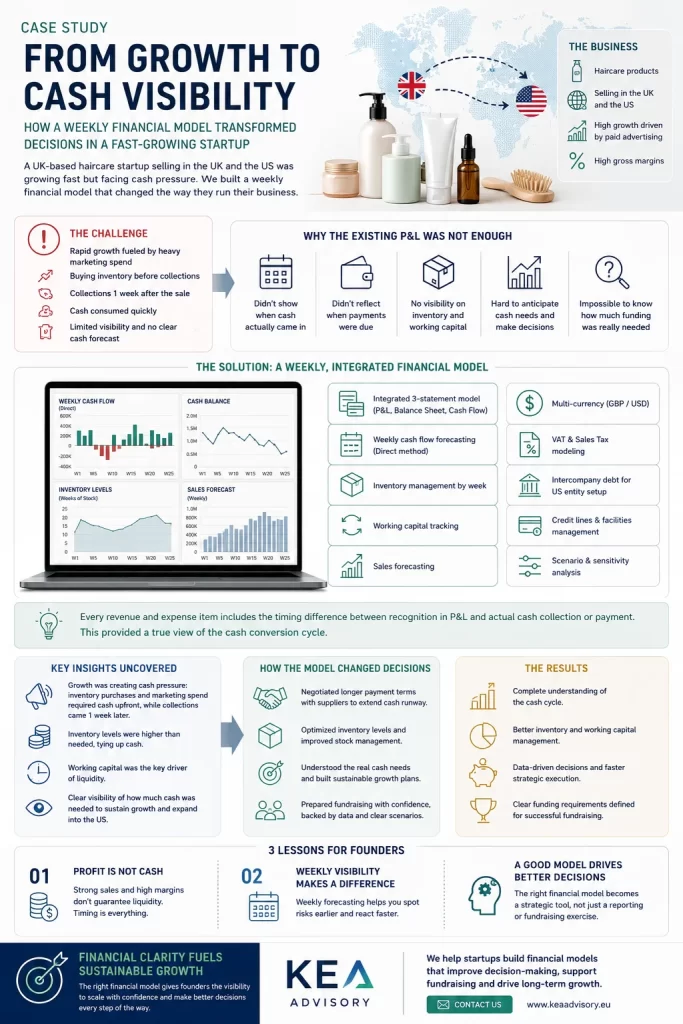
Three Lessons for Startups
1. Profitability Does Not Equal Cash Availability
Many startups focus heavily on revenue and margins while underestimating the importance of timing differences between collections and payments.
Cash flow problems often emerge even in businesses with strong sales performance.
2. Weekly Forecasting Can Be Critical in High-Growth Businesses
Monthly forecasting is often insufficient for startups with fast-moving operations, inventory exposure or significant marketing spend.
Weekly visibility allows founders to react much faster and make better operational decisions.
3. Financial Models Should Support Decisions, Not Just Fundraising
A good financial model is not simply an investor presentation exercise.
It should become a strategic tool that helps founders understand:
- operational risks,
- cash dynamics,
- scalability,
- and future funding needs.
The best models improve decision-making across the entire business.
Final Thoughts
One of the biggest misconceptions in early-stage companies is believing that financial modeling is only necessary for large corporations or fundraising rounds.
In reality, startups often need financial visibility even more.
As companies grow, operational complexity increases rapidly:
- inventory expands,
- marketing spend accelerates,
- supplier relationships become more important,
- and working capital starts driving treasury performance.
Without proper financial planning, founders can lose visibility precisely when decision-making becomes most critical.
At KEA Advisory, we help startups and growing companies build practical financial models that support fundraising, improve strategic decision-making and provide founders with greater financial clarity during periods of rapid growth.