In times of economic uncertainty, geopolitical tensions, and market volatility, cash management shifts from an operational task to a matter of survival. Profitability becomes secondary, while liquidity turns into the primary indicator of financial health.
Yet many companies still rely on models designed for relatively stable environments. The issue is that, under stress, these models tend to fail precisely when they are most needed.
The difference between reacting late and anticipating challenges is rarely intuition — it is usually the tools.
From accounting forecasts to real cash management
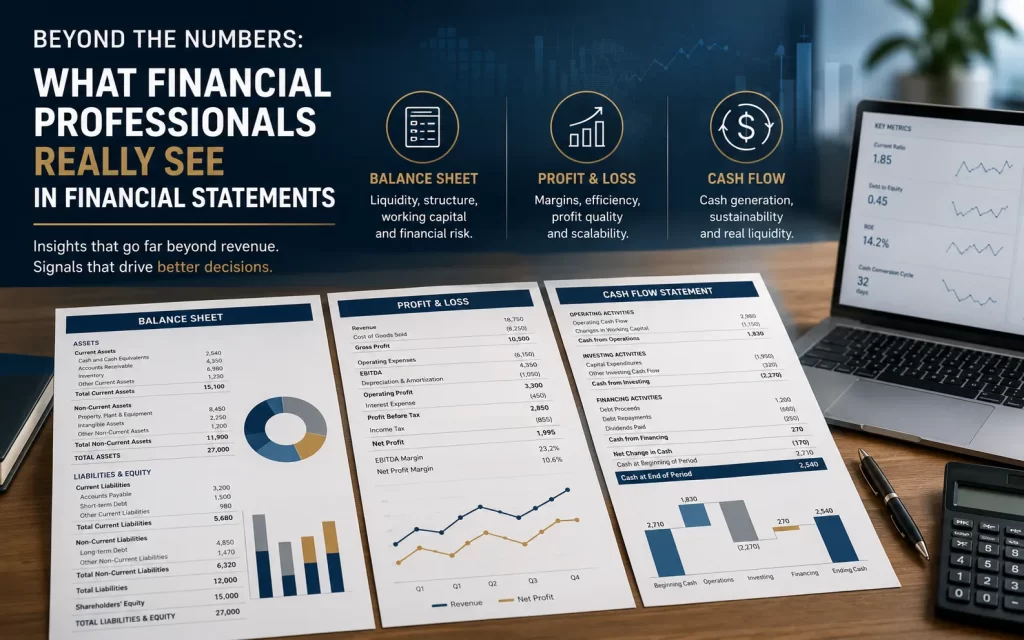
The first shift is understanding that the income statement is not enough. In times of stress, what matters is not how much you sell, but when you collect.
Cash flow forecasting therefore becomes the core tool. Not as a static exercise, but as a dynamic model that provides visibility on short-term cash evolution. In practice, this means working with rolling 13-week forecasts, frequent updates, and focusing on real cash flows rather than accounting assumptions.
Done properly, this transforms cash management from reactive to proactive.
Thinking in scenarios: from forecasting to decision-making
One of the most common mistakes in financial modeling is relying on a single scenario. Under normal conditions, this may be sufficient, but in uncertain environments it introduces unnecessary fragility.
Incorporating scenarios is not simply about adding an optimistic and a pessimistic version. The key lies in identifying which variables truly drive cash and understanding how they interact. Revenue decline, delayed collections, increased financing costs, or changes in working capital do not operate in isolation, but in combination.
A well-structured model allows these variables to be stressed and their impact to be immediately assessed. More importantly, it enables answers to critical decision-making questions: how much headroom the company has, how long it can operate under pressure, and which measures should be triggered if certain assumptions materialize.
At this point, financial modeling stops being an analytical tool and becomes a management instrument.
Releasing cash: operational decisions with immediate impact
Beyond forecasting, many companies overlook one of the most effective levers in times of stress: active working capital management.
Reducing collection periods, negotiating supplier terms, or optimizing inventory levels are not long-term strategic decisions, but they have a direct and, above all, immediate impact on liquidity. In many cases, small improvements in these variables can generate a significant effect on the cash position.
What matters here is not only identifying these levers, but integrating them into the financial model. Only then is it possible to quantify their impact, prioritize actions, and make informed decisions.
Visibility and control: the advantage of dynamic models
In volatile environments, the speed of decision-making is as important as its quality. Having accurate information too late is, in practice, equivalent to not having it at all.
This is why visibility becomes a competitive advantage. Dynamic financial models, supported by clear and updatable dashboards, allow companies to understand their cash position at any given time, detect deviations, and react quickly.
It is not about adding complexity, but about building tools that simplify reality and make it actionable.
Conclusion: cash as a decision-making system
In uncertain environments, the winner is not the company with the best forecasts, but the one with the greatest capacity to adapt.
And that capability does not depend solely on the business, but on the tools used to manage it.
A well-built financial model is not just an Excel file. In practice, it is a decision-making system that enables anticipation, prioritization, and action with sound judgment when visibility is limited.
In a context where variables change rapidly, the ability to understand their impact on cash becomes one of the most valuable assets any organization can have.
Do you need to improve your cash model or financial forecasting?
If you are working on treasury management, financial modeling, or scenario analysis, KEA Advisory can help you develop tools tailored to your business and context.