When a company stays private for long enough, expectations can become larger than reality.
That has been true for SpaceX. For years, investors have speculated about whether the company would ever list publicly and, if so, whether the event would resemble a conventional IPO or something closer to a capital markets milestone.
With SpaceX now publishing its registration statement and formally moving into the public listing process, speculation gives way to something more useful: actual disclosures.
The filing does not answer every question. Pricing, final allocation and some offering mechanics remain subject to change before listing. But it does provide a first structured view into how SpaceX intends to enter public markets—and, more importantly, what public investors would actually be buying. (SEC)
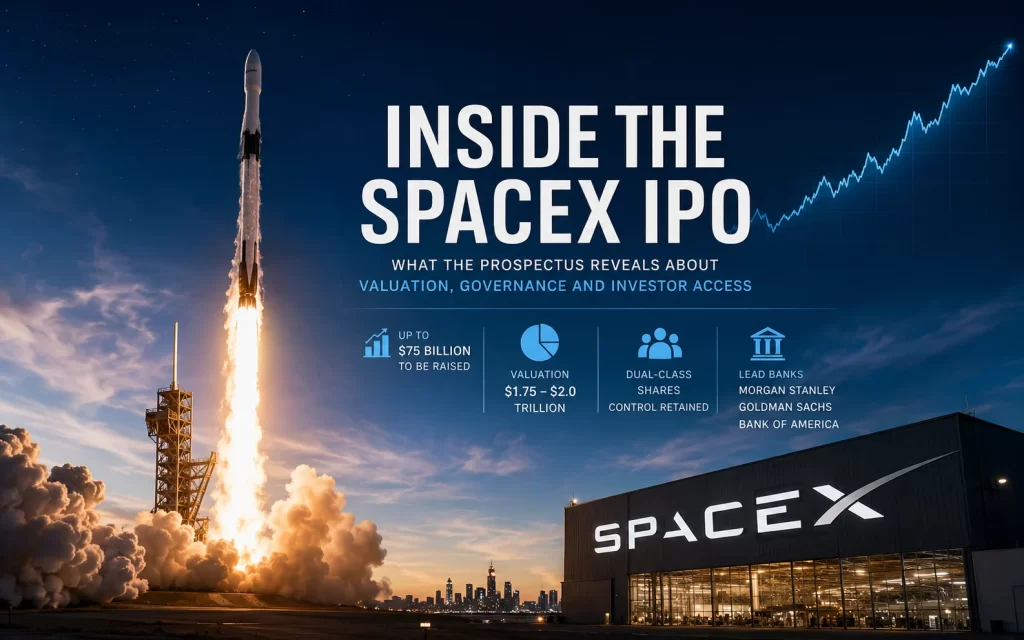
Key IPO Terms at a Glance
| Item | Current indication from filing |
| Company | Space Exploration Technologies Corp. |
| Listing venue | Nasdaq |
| Proposed ticker | SPCX |
| Offering type | Initial Public Offering |
| Target valuation | Approximately $1.75–2.0 trillion (market expectations and reported targets) |
| Estimated capital raise | Up to ~$75 billion |
| Share structure | Dual-class |
| Public investor class | Class A |
| Insider control class | Class B |
| Lead banks | Morgan Stanley, Goldman Sachs, Bank of America (reported syndicate leadership) |
| Control after listing | Expected to remain with Elon Musk and insiders |
Final pricing and allocation remain subject to completion of the roadshow process and regulatory review. (Reuters)
Why This IPO Matters
SpaceX is not arriving at public markets as a venture-backed growth company seeking survival capital.
It arrives as a company that already operates at extraordinary scale across launch services, satellite communications and adjacent infrastructure initiatives.
That distinction matters.
Traditional IPOs often represent a transition from private experimentation to public execution. SpaceX appears to be presenting a different proposition: opening ownership while preserving strategic control and long-term investment flexibility. (SEC)
The scale alone is notable. Based on current reported expectations, SpaceX could become one of the largest public offerings ever attempted and potentially exceed historical IPO valuation records. (Reuters)
From Private Capital to Public Markets
SpaceX has historically relied on private funding rounds and secondary transactions rather than public equity.
That model worked because access to capital was rarely constrained. Investor demand consistently supported rising private valuations, while management retained flexibility and avoided quarterly market pressure.
The filing suggests that the rationale for listing is broader than financing alone.
Public status potentially provides:
- a liquid ownership structure;
- broader institutional access;
- acquisition currency;
- visibility for future capital needs;
- and a scalable framework for long-duration investment programmes.
Importantly, the prospectus does not present the IPO as an exit event. It frames the transaction within a longer-term capital formation story. (SEC)
What the Filing Says About the Deal Structure
One of the most closely watched questions has been simple: how exactly will SpaceX go public?
The current filing indicates a conventional IPO structure rather than a direct listing.
That means public investors would purchase newly issued publicly traded shares while the company raises fresh capital. The underwriting process is reported to be led by a large syndicate of investment banks including Morgan Stanley, Goldman Sachs and Bank of America. (TradingView)
Although final allocation mechanics are not yet fixed, large institutional participation appears central to the process.
For executives and investors, this distinction matters because IPO design influences:
- post-listing liquidity;
- shareholder concentration;
- price stability;
- and future capital flexibility.
The filing also reinforces that offering size should not automatically be interpreted as immediate operational funding requirements. Large issuers often optimise timing, liquidity and strategic optionality rather than raising only what is strictly necessary.
How Shares Will Be Structured — and Who Will Actually Hold Power
Perhaps the clearest takeaway from the filing is that public ownership does not necessarily mean public control.
SpaceX intends to use a dual-class share structure.
Under the reported framework:
- Class A shares (public investors) carry standard voting rights.
- Class B shares (primarily held by insiders) carry enhanced voting rights.
Reported disclosures indicate Class B shares receive ten votes per share, preserving effective control with Elon Musk and a concentrated insider group even after listing. (Reuters)
This distinction is worth emphasising because it changes what investors are purchasing.
Public shareholders may gain economic participation in SpaceX’s future performance, but governance influence appears designed to remain highly concentrated.
That approach is not unusual among founder-led technology companies.
What is unusual is the scale.
The filing indicates SpaceX also intends to qualify under Nasdaq’s controlled company framework, which allows exemptions from certain governance expectations typically applied to public issuers. (TradingView)
For executives and long-term investors, the practical implication is straightforward:
Ownership and control are not the same thing.
Is Tesla Involved?
This is likely to become one of the most misunderstood parts of the transaction.
The short answer is: SpaceX is not becoming public through Tesla, and Tesla is not conducting the IPO.
Legally and structurally, they remain separate corporate entities.
However, the filing reveals that the relationship between the companies is more extensive than many investors may have assumed.
The prospectus reportedly discloses commercial transactions and operational links across businesses associated with Elon Musk, including infrastructure purchases, energy systems and broader technology initiatives. It also highlights areas of collaboration involving AI infrastructure and supply-chain initiatives. (Business Insider)
At the same time, investors should avoid overextending the conclusion.
Operational relationships do not automatically imply shared economics.
Buying SpaceX shares would not mean buying Tesla exposure, and owning Tesla does not create direct participation in SpaceX’s IPO economics.
The more useful interpretation may be this:
the filing illustrates an increasingly interconnected operating ecosystem, while preserving separate public ownership structures. (Barron’s)
What Investors Are Actually Being Asked to Believe
One of the most interesting elements of the filing is not financial—it is conceptual.
SpaceX is not positioning itself solely as a launch company.
The prospectus frames the opportunity set across satellite connectivity, infrastructure, advanced computing and long-duration technology investment themes. (Reuters)
That creates both opportunity and complexity.
Unlike mature industrial listings, valuation becomes harder because investors are not underwriting a single business line—they are underwriting a portfolio of future possibilities.
For that reason, the filing should probably be read less as a near-term earnings document and more as a capital allocation document.
The question is not simply whether current financial performance supports the valuation.
The question is whether investors believe the structure being created can convert ambition into durable economic outcomes over time.
Final Thoughts
IPO filings often remove uncertainty.
This one may create new forms of it.
The SpaceX prospectus clarifies mechanics, governance and ownership, but it also confirms something that many suspected for years: public listing does not necessarily mean a company becomes conventionally public.
The structure outlined so far appears designed to expand access to ownership while maintaining concentrated strategic control.
Whether investors view that as alignment or limitation will likely become one of the defining debates of the offering.
Either way, the filing has moved the conversation from if SpaceX goes public to what public ownership of SpaceX actually means. (SEC)