
A financial model is often one of the first tools a startup builds. In its early stages, it may be relatively simple: estimate revenue, forecast expenses, calculate cash burn and determine how long available capital will last.
At that point, the main question is straightforward: how much money does the business need to get started?
But as a startup grows, the questions become more complex.
Revenue increases, new employees are hired, products are developed and markets are entered. Decisions that once had a limited financial impact can now influence cash requirements, profitability and the company’s ability to scale.
The financial model that was sufficient during the early stages may no longer be adequate.
Growth changes not only the size of a startup, but also the way its financial performance needs to be understood.
From forecasting survival to managing growth
In the early stages, financial planning is largely focused on survival. Founders need to understand initial costs, expected cash burn, available funding and runway.
As the company grows, however, simply forecasting revenue and expenses becomes increasingly limited.
A startup may be generating more revenue and attracting customers, but that does not necessarily mean its business model is financially sustainable. Growth can require additional working capital, higher fixed costs, increased marketing expenditure and investment in infrastructure.
A company may double its sales while simultaneously increasing customer acquisition costs, extending payment terms and hiring ahead of demand. Revenue looks encouraging, but its cash position could deteriorate.
Growing startups therefore need to understand the financial mechanics behind their growth. The question is no longer just how long the company can survive, but whether its business model can support the next stage of expansion.
Revenue growth is not the same as financial progress
Revenue is important, but it does not tell the whole story.
A growing company needs to understand how revenue is generated, how much it costs to acquire and serve customers, how quickly cash is collected and whether the economics of the business improve as it scales.
Depending on the business, relevant metrics may include customer acquisition cost (CAC), lifetime value (LTV), churn, gross margin, contribution margin and working capital requirements.
These metrics help assess unit economics: the financial contribution generated by each customer, transaction or unit sold.
For example, a subscription-based business may be growing its customer base rapidly, but if acquisition costs remain high or customers leave before generating sufficient revenue, growth may actually destroy value.
Similarly, a business selling physical products may increase revenue while experiencing lower margins due to production, logistics or distribution costs.
The objective is not to include as many metrics as possible, but to identify the variables that explain how the business generates value and consumes resources.
A useful financial model does not simply show how much a company expects to grow. It explains what makes that growth financially sustainable.
From a static budget to an operational model
As a startup expands, its financial performance becomes increasingly connected to operational decisions.
Sales may depend on the number of salespeople, conversion rates and average contract value. Customer support costs may increase with the number of active customers. Technology expenditure may depend on usage and infrastructure requirements.
Hiring decisions also become more significant. A company may need to recruit ahead of expected revenue growth, increasing costs before additional capacity generates returns.
A financial model should reflect these relationships rather than simply applying a percentage increase to previous expenses.
This is the difference between a financial projection and an operationally driven model: the latter connects financial results to the actual activities of the business and helps management understand which assumptions need to hold true.
It also allows founders to evaluate the consequences of operational decisions before committing resources. For example, what would be the financial impact of opening a new market, launching an additional product or expanding the sales team?
These decisions should not be assessed in isolation. Their impact on revenue, costs, investment requirements and cash flow needs to be considered together.
Cash flow and the capital required to scale
Profitability and cash flow are closely related, but they are not interchangeable.
A startup can report positive EBITDA while continuing to consume cash due to inventory requirements, delayed customer payments, capital expenditure or expansion.
As the business grows, these differences can become increasingly important. Higher sales may require more inventory, longer payment terms or additional infrastructure. The company may therefore need to invest cash before receiving the corresponding revenue.
For this reason, a growing startup needs a financial model that connects its income statement, balance sheet and cash flow statement.
This integrated approach helps management anticipate liquidity constraints and understand how operating decisions translate into funding requirements.
It also provides a clearer picture of capital allocation. When resources are limited, founders must decide whether to invest in hiring, product development, marketing, technology or geographic expansion. Each decision has an opportunity cost, and the financial model should help compare the expected returns and risks.
Scenario analysis: preparing for different outcomes
Startups operate in environments characterised by uncertainty. Market conditions change, customer acquisition may take longer than expected, funding rounds can be delayed and costs rarely evolve exactly as planned.
A single forecast cannot capture all these possibilities.
A growing startup should therefore use financial models to evaluate different scenarios. A base case may reflect the expected development of the business, while a conservative scenario could incorporate slower revenue growth, higher operating costs or delayed customer payments.
However, scenario analysis should go beyond changing the final revenue figure. It should show how different assumptions affect hiring requirements, operating expenses, working capital, cash burn and funding needs.
What happens if revenue grows more slowly than expected? Does the company still have sufficient runway? Which investments could be postponed? At what point would additional funding become necessary?
The purpose is not to predict which outcome will occur, but to understand the consequences of different possibilities and prepare management to respond.
Conclusion: growth requires financial visibility
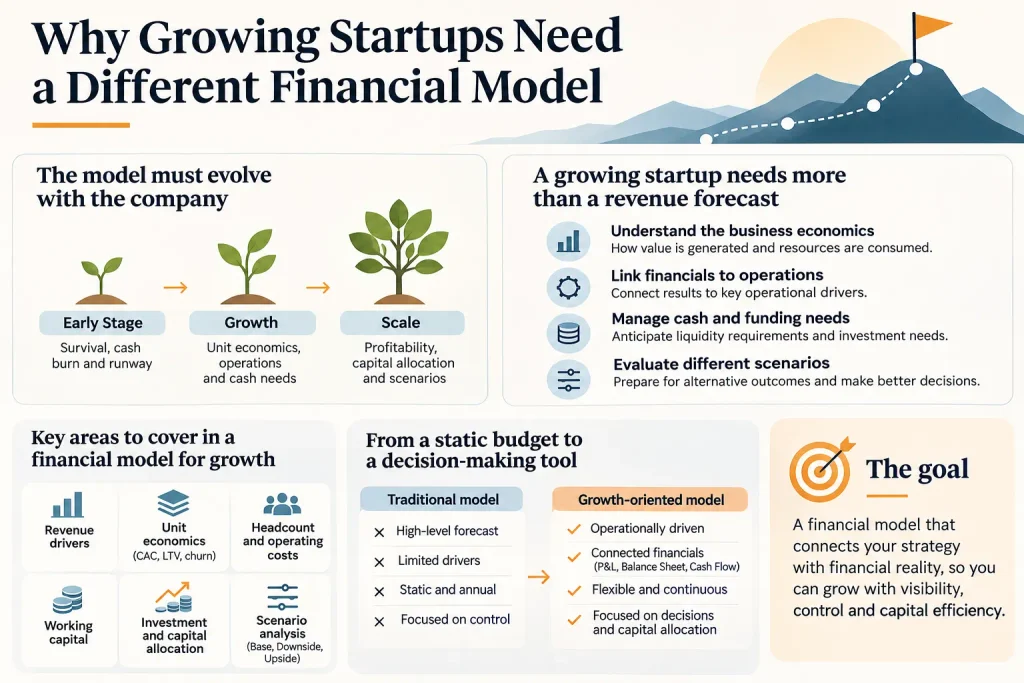
There is no single financial model suitable for every startup or every stage of development. An early-stage business may focus on cash burn and runway, while a company entering rapid expansion needs greater visibility over revenue drivers, margins, headcount, working capital and investment requirements.
The model should evolve alongside the organisation, providing enough detail to support meaningful decisions without becoming unnecessarily complex.
It should also become a continuous management process rather than an exercise performed only when preparing a budget or approaching investors. Actual performance needs to be compared with expectations, assumptions reviewed and projections updated as the business evolves.
Ultimately, a financial model should not be treated as a document prepared for investors or updated once a year for budgeting purposes.
It should be a management tool that connects business strategy with financial reality.
Because growth creates opportunities. But without financial visibility, it can also create risks that are difficult to identify until they become problems.