
France is no longer just dealing with a difficult public-finance debate. Its debt has become a market issue.
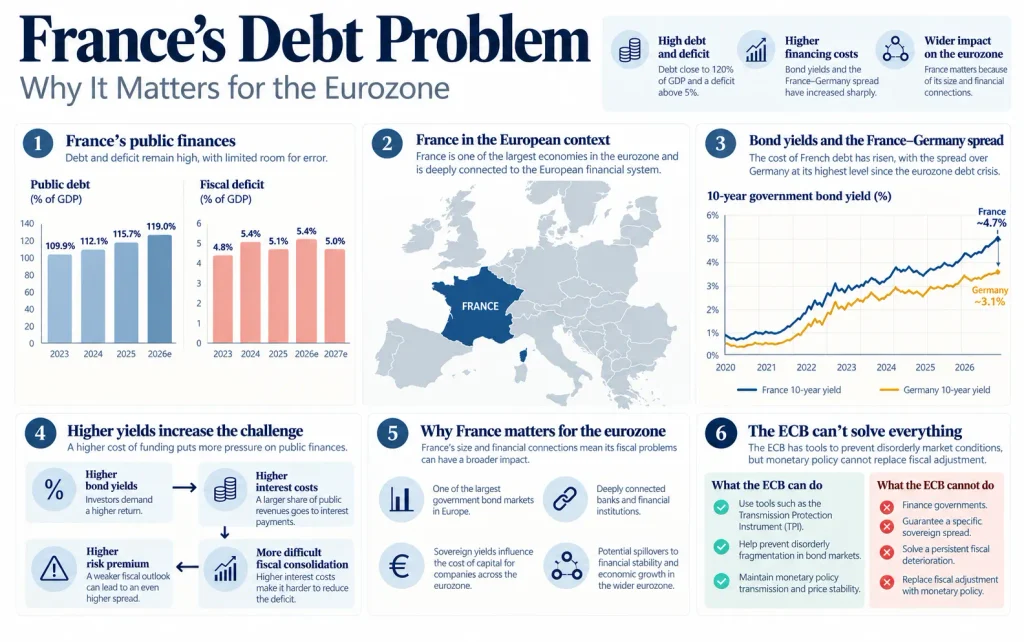
French government bond yields have risen sharply, with the 10-year yield approaching 5% and the spread over German Bunds reaching levels last seen during the eurozone debt crisis. On October 5, the France-Germany spread moved above 150 basis points, while the euro fell to a 17-month low amid growing concerns about France’s fiscal position and political uncertainty.
That does not mean France is heading towards a sovereign debt crisis. But it does raise a more interesting question: why can problems in one country become a problem for the rest of the eurozone?
France’s problem is not simply the amount of debt
France entered 2026 with already significant fiscal imbalances. Public debt was 115.7% of GDP in 2025, while the deficit stood at 5.1% of GDP. The French government now expects the deficit to reach 5.4% of GDP in 2026 and is targeting 5% in 2027. At the same time, debt is expected to reach around 119% of GDP this year.
Those numbers are high, but the debt-to-GDP ratio alone does not tell us whether a country is financially sustainable.
The more important question is what happens when the cost of financing increases while the deficit remains large.
France illustrates this particularly well. The government estimates that interest payments will rise from €79.2 billion in 2026 to €91.2 billion in 2027. That is money that cannot simultaneously be used for infrastructure, public services, investment or other priorities.
This creates a familiar financial dynamic. If a company has high debt but strong cash generation and low refinancing costs, the debt may be manageable. If cash generation weakens while financing costs rise, the same amount of debt can become much more difficult to sustain.
The same principle applies to governments.
The market is already asking for a higher return
This is where the bond market becomes important.
Investors do not simply ask whether France will repay its debt. They also ask what return they require to hold French debt instead of another eurozone sovereign bond.
Germany is effectively the reference point for this comparison. When the yield on a French 10-year bond rises relative to the German equivalent, the difference is commonly described as the France-Germany spread.
That spread has widened dramatically. By early October, it had moved above 150 basis points, its highest level since the eurozone debt crisis.
This is important because a higher spread does not only make existing debt more expensive when it is refinanced. It also changes the economics of future borrowing.
And this is where the problem can become self-reinforcing.
Higher yields increase interest costs. Higher interest costs make fiscal consolidation harder. A weaker fiscal outlook can make investors demand an even higher risk premium. That higher risk premium then increases the cost of borrowing again.
The numbers do not have to become catastrophic for this mechanism to matter.
Why France is different from a smaller eurozone country
France matters because of its size.
A fiscal problem in a small eurozone economy can be serious without necessarily changing the functioning of the entire currency union. France is different because its government bond market is one of the largest in Europe and French banks and financial institutions are deeply connected to the rest of the European financial system.
This means that a significant repricing of French sovereign debt can affect more than the French government.
Banks hold sovereign bonds. Investors hold sovereign bonds. Insurance companies and pension institutions hold sovereign bonds. Corporate financing conditions are influenced by sovereign yields. And government bond yields provide an important reference point for the pricing of other financial assets.
The ECB itself has highlighted the potential feedback loop between sovereigns, financial markets and the real economy: deterioration in sovereign financing conditions can spill over into corporate financing and reinforce financial-stability risks.
That is why the French situation deserves attention beyond France.
The difficult position of the ECB
There is another complication.
The European Central Bank has a mandate to maintain price stability, not to finance governments or guarantee that every eurozone country can borrow at a particular interest rate.
The ECB does have tools designed to address disorderly fragmentation in eurozone bond markets, including the Transmission Protection Instrument. But its use comes with conditions, precisely to avoid creating incentives for governments to ignore fiscal sustainability.
Recent comments from ECB policymakers have also stressed that the central bank’s intervention tools are aimed at maintaining monetary-policy transmission and price stability rather than targeting a particular sovereign spread.
This creates an uncomfortable balance.
If markets become disorderly, the ECB may have tools to prevent fragmentation. But if the underlying problem is persistent fiscal deterioration, monetary policy cannot solve it.
A central bank can influence financing conditions. It cannot permanently replace fiscal adjustment.
The real issue is credibility
This is perhaps the most important part of the French story.
Debt sustainability is not determined by one year’s deficit or one day’s bond yield. It depends on the relationship between economic growth, primary balances, interest rates and the existing stock of debt.
France does not need to eliminate its debt. Nor does a high debt ratio automatically imply a crisis.
But investors need to believe that the trajectory can eventually be stabilised.
That is why the government’s 2027 budget matters. The proposed package aims to reduce the deficit to 5% of GDP through a €54 billion consolidation effort, although the political process required to approve it remains difficult.
The market is therefore watching not only the numbers, but whether France can actually implement the measures necessary to change the trajectory.
What France can teach the rest of Europe
The French situation is a useful reminder that public debt is ultimately a capital-allocation problem.
Every euro spent servicing debt is a euro that cannot be allocated elsewhere. When financing is cheap, this trade-off can remain relatively invisible. When interest rates rise and investors demand a larger risk premium, it becomes much more difficult to ignore.
And this is why France matters for the eurozone.
The important question is not whether France has “too much debt” in isolation. It is whether the combination of high debt, persistent deficits, rising financing costs and limited fiscal flexibility can eventually change how investors price sovereign risk across Europe.
So far, there is no evidence of a eurozone-wide sovereign crisis. But the widening divergence between French and German borrowing costs shows that markets are already distinguishing more sharply between different fiscal positions.
For governments, companies and investors, the lesson is remarkably similar: financial resilience is not about having no debt. It is about having enough capacity to absorb a change in the cost of capital without being forced into decisions you would not otherwise make.
France’s debt problem is therefore not only a French problem. It is a test of how much fiscal and financial resilience the eurozone has built since the last sovereign debt crisis.