Growth is one of the most common objectives in business. Companies seek to increase revenue, enter new markets, expand their customer base and improve profitability. But as a business develops, an important question emerges: should it continue growing organically, or could an acquisition be a better way to reach its objectives?
Organic and inorganic growth are often presented as alternatives. In practice, both can create value, and both can destroy it. The relevant question is not which approach generates growth faster, but which offers the most attractive risk-adjusted return on the capital invested.
Organic growth: building on what already works
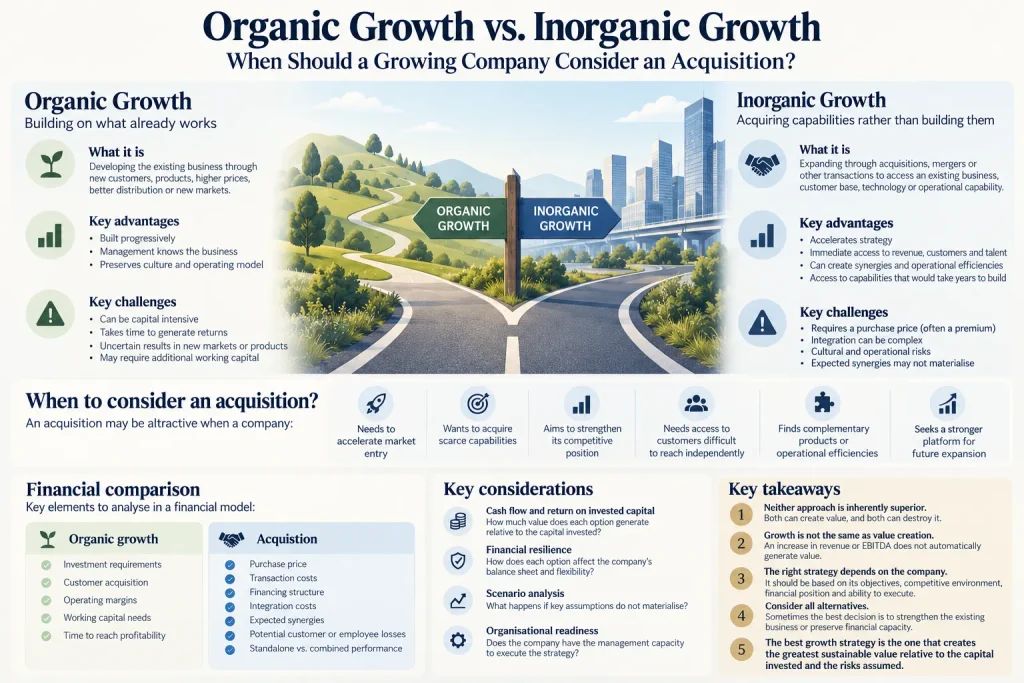
Organic growth comes from developing the existing business. A company may acquire new customers, launch products, increase prices, improve distribution or enter new markets using its own resources and capabilities.
One advantage is that growth can be built progressively. Management already understands the business model, customer relationships and operational processes. Investments can be made in stages, allowing the company to assess results before committing additional resources.
However, organic growth is not necessarily cheap or low-risk. Entering a new market may require substantial investment in personnel, marketing and infrastructure before generating meaningful revenue. Developing a new product can involve years of expenditure with uncertain results. Even expanding an established operation may require additional working capital and capacity.
Growth also takes time. If competitors are consolidating or a market opportunity is closing, developing every capability internally may be too slow.
The financial challenge is to understand not only how much revenue organic growth could generate, but also how much capital it requires, how long it takes to produce returns and what risks arise along the way.
Inorganic growth: acquiring capabilities rather than building them
Inorganic growth involves expanding through acquisitions, mergers or other transactions that provide access to an existing business, customer base, technology or operational capability.
An acquisition can accelerate a strategy that would otherwise take years. A company may acquire a competitor to strengthen its market position, purchase a distributor to reach new customers or acquire a specialised business to access expertise it lacks.
An acquisition can provide immediate access to established revenue streams, employees, infrastructure and commercial relationships. It may also create opportunities to combine operations, reduce duplicated costs or cross-sell products.
But speed comes at a price. The buyer must pay for the business, often including a premium for expected growth or strategic benefits. The transaction may also require external financing, professional fees, integration expenditure and additional working capital.
Furthermore, the acquired business does not automatically become more valuable as part of a larger organisation. Cultural differences, incompatible systems and management challenges can undermine expected benefits. Customers may leave, key employees may depart, and synergies may prove harder to achieve than anticipated.
An acquisition does not eliminate the risks of growth. It changes their nature. The buyer takes on the risks of paying the right price, assessing the business correctly and integrating it successfully.
When should a company consider an acquisition?
The decision should start with the company’s strategic objectives, not with the availability of a target.
An acquisition may be attractive when a company needs to accelerate market entry, acquire scarce capabilities, strengthen its competitive position or access customers that would be difficult to reach independently. It may also make sense when the target offers complementary products, operational efficiencies or a stronger platform for expansion.
Consider a company generating €10 million in annual revenue that wants to enter a new geographical market. Building an operation from scratch might require years of investment in local personnel, marketing and distribution. Acquiring an established competitor could provide immediate access to customers and infrastructure.
However, the acquisition only makes sense if its expected benefits justify the purchase price and additional risks. If the target is expensive, dependent on a few customers or difficult to integrate, organic expansion may offer a better financial outcome.
Organisational readiness matters too. A company that struggles to manage its existing operations may find that an acquisition compounds its problems. Successful integration requires management capacity, reliable financial information, clear accountability and the ability to monitor performance across a larger organisation.
The financial model: comparing the alternatives
Financial modelling helps management compare the complete financial consequences of each strategy over a consistent time horizon.
For organic growth, the analysis should include investment requirements, customer acquisition, operating margins, working capital and the time needed to reach profitability.
For an acquisition, the model should incorporate the purchase price, transaction costs, financing structure, integration expenditure, expected synergies and potential customer or employee losses. It should distinguish between the target’s standalone performance and the additional value expected from combining the businesses.
The comparison should consider cash flow, return on invested capital and financial resilience. An acquisition funded with debt may increase earnings while reducing financial flexibility. Organic expansion may appear less expensive but consume substantial cash before generating returns.
Scenario analysis is equally important. What happens if revenue grows more slowly than expected, integration costs exceed the budget or synergies take longer to materialise? Could the company continue servicing its debt if the acquired business underperforms?
The objective is not to predict the future precisely. It is to understand which assumptions drive the decision, how sensitive returns are to those assumptions and whether the company can withstand an unfavourable outcome.
Growth is not the same as value creation
One common mistake is treating an increase in revenue or EBITDA as sufficient evidence of success.
An acquisition can increase both immediately, yet destroy value if the purchase price is excessive or the capital invested generates an inadequate return. Similarly, organic growth can increase sales while putting pressure on cash flow, particularly when expansion requires significant working capital or ongoing investment.
The relevant question is whether incremental returns justify the capital committed, considering the risks and alternative uses of that capital.
An acquisition should also be assessed against the option of not investing. Sometimes the best decision is to strengthen the existing business, improve profitability or preserve financial capacity rather than pursue growth for its own sake.
Choosing the right growth strategy
Organic and inorganic growth are not mutually exclusive. A company can develop its core business internally while using acquisitions selectively to fill capability gaps, enter new markets or accelerate strategic initiatives.
The right balance depends on the company’s objectives, competitive environment, financial position and ability to execute. Organic growth may offer greater control and a more gradual commitment of capital. Acquisitions may offer speed and access to capabilities that would otherwise take years to develop.
Neither approach is inherently superior.
The best growth strategy is not necessarily the one that makes a company bigger the fastest. It is the one that creates the greatest sustainable value relative to the capital invested and the risks assumed.
Before deciding whether to build or buy, management should understand what it wants to achieve, what each alternative will cost, how each will affect cash flow and financial resilience, and what must be true for the investment to succeed.
Growth is an outcome. Value creation is the objective.