The potential combination of Tesla and SpaceX raises a fundamental question in corporate finance: when do strategic synergies justify bringing two businesses together?
The idea of combining Tesla and SpaceX is becoming more than a hypothetical discussion. Both companies have established special committees to examine a potential transaction, although no final agreement has been reached. Elon Musk has publicly supported the idea, but a merger is far from guaranteed.
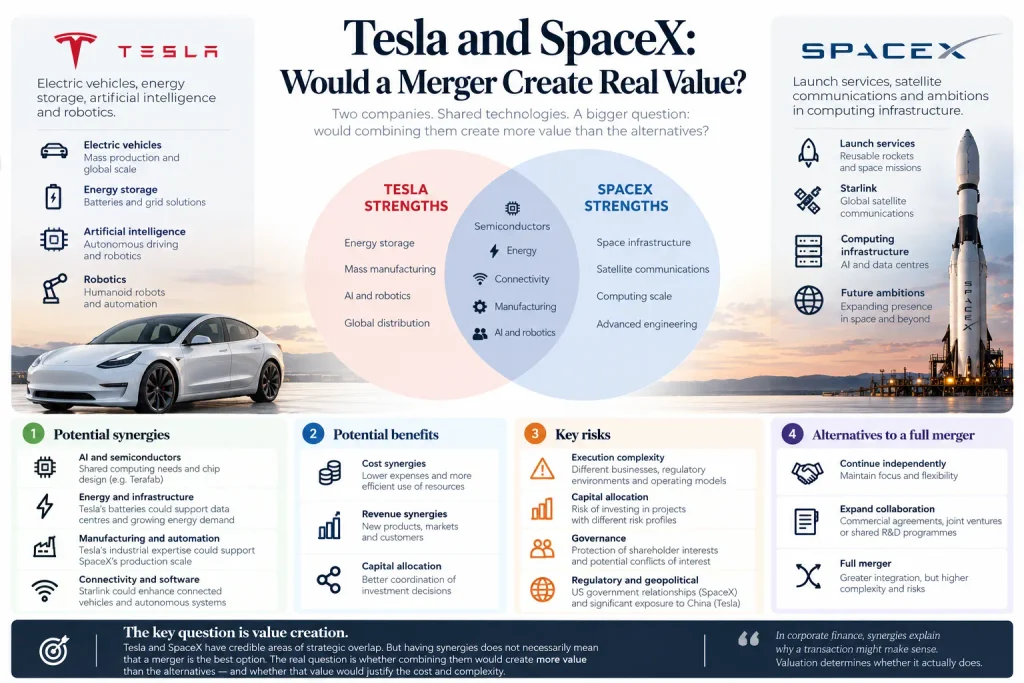
At first glance, the strategic rationale is compelling. Tesla operates across electric vehicles, energy storage, artificial intelligence and robotics. SpaceX combines launch services, satellite communications through Starlink and ambitions in computing infrastructure. Both companies are investing heavily in technologies that increasingly overlap.
A combination could accelerate projects, simplify coordination and improve the allocation of resources. Yet these potential advantages do not automatically mean a merger would create value.
The question is not simply whether Tesla and SpaceX could work better together, but whether combining them would produce greater economic value than the alternatives.
Where could the synergies come from?
The strongest argument for a merger lies in the growing overlap between the companies’ technological and industrial ambitions.
One potential area is artificial intelligence and computing infrastructure. Tesla needs advanced computing capabilities for autonomous driving, robotics and software development. SpaceX is also expanding its AI and data-centre ambitions. Both face substantial requirements for specialised chips, processing capacity and energy.
The announced Terafab initiative illustrates this overlap. The project aims to develop semiconductor manufacturing capabilities to support computing needs. Greater integration could improve coordination across chip design, manufacturing and deployment. However, the project also demonstrates that collaboration is possible without a full corporate merger.
Energy offers another opportunity. Tesla’s battery and energy-storage business could support the growing electricity requirements of AI infrastructure and data centres. Combining demand, technology and investment planning could improve procurement and deployment economics.
Manufacturing and automation may also provide benefits. Tesla’s experience in large-scale production and factory automation could be useful as SpaceX expands its manufacturing capabilities. However, the transferability of this expertise should not be taken for granted: producing electric vehicles and launch vehicles involves different technical requirements, supply chains and regulatory constraints.
Finally, there may be opportunities in software, connectivity and robotics. Starlink could potentially support connected vehicles and autonomous systems, while advances in AI and robotics could benefit both organisations.
These opportunities are worth examining, but each requires a clear explanation of the additional value it could generate, the investment required and the probability of success.
Strategic fit is not the same as financial value
A common mistake in merger discussions is to assume that a stronger strategic narrative necessarily translates into a better financial outcome.
Cost synergies arise when a combined organisation can reduce expenses or use resources more efficiently. Revenue synergies emerge when the combination enables additional sales, new products or access to customers. Capital-allocation benefits may arise when investment decisions can be coordinated more effectively.
But each category needs to be quantified. A projected saving in five years is not equivalent to a saving today, and a potential business opportunity is not the same as an established revenue stream. The more uncertain the outcome, the more carefully it should be reflected in the analysis.
The same principle applies to growth. A merger might enable projects that would be more difficult to execute independently, but those projects could also require substantial additional capital and involve significant commercial and technological uncertainty.
Higher revenue, faster expansion or a larger combined valuation would not, on their own, prove that shareholders had benefited. The relevant question is whether the expected returns justify the capital invested and the risks assumed.
Could the companies capture the same benefits without merging?
This may be the most important question in the discussion.
A full merger is only one way to achieve strategic cooperation. The companies could also use commercial agreements, joint ventures, shared research programmes or targeted investments. These arrangements can provide access to complementary capabilities while allowing each business to retain its own governance and strategic flexibility.
Terafab illustrates this possibility. Its development may demonstrate the value of closer coordination, but it also raises a question: how much additional value would a full merger create beyond what existing collaboration can deliver?
A merger might make sense if separate ownership creates persistent obstacles to investment, slows critical decisions or prevents the companies from capturing significant benefits. If commercial agreements can achieve similar outcomes at a lower cost and with less risk, a full combination may be unnecessary.
The financial analysis should therefore compare three alternatives: continuing independently, expanding cooperation through specific agreements and pursuing a full merger. Each should be evaluated on its expected cash flows, investment requirements, implementation costs and risks.
The risks of combining two complex businesses
Even if the strategic benefits are substantial, the costs and risks should not be underestimated.
The first challenge is execution. Integrating organisations with different operating models, customers and regulatory environments can consume management attention and delay existing projects.
The second is capital allocation. A combined organisation could gain flexibility to direct resources towards promising opportunities, but it could also make it harder to assess projects with very different risk profiles. A larger company does not necessarily allocate capital better than two independent businesses.
Governance is equally important. Elon Musk leads both organisations, but their ownership and voting structures differ. Any transaction would need to address how the interests of shareholders on both sides are protected and whether the proposed terms fairly reflect the relative value of the businesses.
Regulatory and geopolitical issues add further complexity. SpaceX has significant relationships with US government agencies, while Tesla has important manufacturing and commercial exposure to China. Combining these activities could introduce additional scrutiny and constraints.
What would a financial model need to demonstrate?
A rigorous analysis should begin with the value of the two businesses as independent entities. It should then estimate the incremental cash flows generated by the merger, rather than attributing the existing value of each company to the transaction.
This requires identifying the synergies, estimating when they could be realised, calculating integration costs and assessing the investment needed to support the combined strategy. The model should also examine downside scenarios, including delayed projects, higher capital expenditure and synergies that fail to materialise.
The resulting analysis should compare the value of the combined business with the value of Tesla and SpaceX operating independently, after accounting for transaction and integration costs.
Crucially, even if a merger creates value in aggregate, not every shareholder necessarily benefits. The exchange ratio, valuation assumptions and allocation of control can determine whether the transaction is attractive to one group of shareholders but not the other.
Ultimately, the model should answer three questions: what additional value can the merger create, what must be invested to achieve it, and who captures that value?
The real question is value creation
Tesla and SpaceX have credible areas of strategic overlap. AI, semiconductors, energy, robotics and advanced manufacturing could provide meaningful opportunities for cooperation. The potential combination therefore deserves serious analysis.
But strategic compatibility is only the starting point. A successful merger must translate that compatibility into additional cash flows, attractive returns on invested capital and a better risk-adjusted outcome for shareholders than the available alternatives.
The companies may conclude that a full merger is the best way to achieve those objectives. They may instead find that targeted cooperation offers a better balance between opportunity, flexibility and risk.
The most important question is not whether Tesla and SpaceX could become a more powerful organisation together. It is whether they could create more value together than they could independently — and whether that additional value would justify the cost and complexity of combining them.
In corporate finance, synergies explain why a transaction might make sense. Valuation determines whether it actually does.