
An Expanding Ecosystem
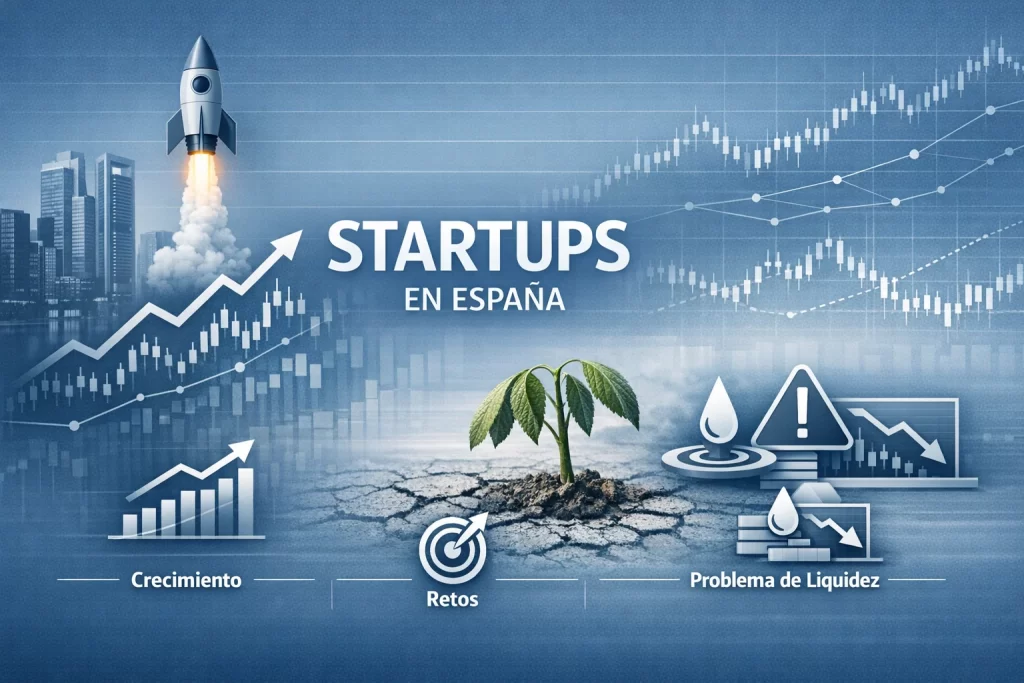
The startup ecosystem in Spain has grown significantly in recent years. It is currently estimated that between 3,000 and 4,500 startups are active, with more than 5,000 new ventures created in recent years. Sectors such as technology, fintech, healthcare, and artificial intelligence account for much of this growth, driven by access to talent, capital, and an increasingly connected international environment.
This dynamism reflects a positive reality: starting a business today is more accessible than it was a decade ago. However, this growth in numbers coexists with structural fragility. Spain remains a developing ecosystem, where launching a startup is relatively feasible, but consolidating it continues to be the real challenge.
The Reality of Survival
If there is one figure that truly defines the ecosystem, it is not the number of startups born, but the number that survive.
It is estimated that around 70% of startups do not make it past their first five years, and a significant portion fails even earlier, during the initial validation phases. In many cases, closure occurs without having achieved recurring revenue or a solid customer base.
This means that although the influx of new companies is high, only a minority manage to consolidate. Growth, therefore, is not the main problem; sustaining it over time is.
Sectors and Development Patterns
The growth of the ecosystem is not homogeneous, and certain sectors stand out both in terms of volume and scalability.
Tech startups, especially those based on SaaS or fintech models, lead this development. Examples include Typeform, which has built a global digital interaction platform, and Flywire, specialized in international payment solutions.
In mobility and digital platforms, companies like Cabify and Glovo illustrate how tech-driven models can scale rapidly and compete internationally.
The health and biotech sectors are also gaining weight, while in the industrial and energy sectors, companies like Wallbox, focused on electric vehicle charging solutions, are emerging.
Even traditional sectors in Spain, such as tourism or employment, have evolved toward more innovative models, with examples like TravelPerk or Jobandtalent transforming established industries through technology.
Beyond the sector, a common pattern emerges: increasingly scalable models, a growing B2B focus, and earlier internationalization.
Why Startups Fail
When analyzing why startups fail, apparent causes often vary: lack of market, competition, team issues, or difficulties in raising capital. However, a cross-cutting factor emerges upon closer examination.
In Spain, approximately 60%–70% of closures are related to liquidity problems or lack of funding. In other words, failure often occurs not because the idea is invalid, but because the company runs out of resources before it can execute properly.
This is compounded by a frequent reality: overly optimistic revenue forecasts, underestimated costs, and financial management that is often reactive rather than proactive. The result is a progressive imbalance between growth and available resources.
The Role of Financial Planning
In this context, financial planning plays a central role. It is not just about projecting figures but understanding how the business may evolve under different scenarios.
A well-constructed financial model should consider multiple scenarios from the outset. For example:
Base scenario: the business evolves as expected.
Conservative scenario: slower revenue growth or higher customer acquisition costs.
Stress scenario: for instance, a delayed or failed funding round.
An acceleration scenario can also be considered, where demand exceeds expectations, requiring anticipatory decisions such as expanding the team, investing in technology, or entering new markets.
This approach allows key questions to be answered with greater rigor: how long can the company operate with available cash, when will it need to seek funding, or which levers can be adjusted if the environment changes.
Beyond analysis, the main value lies in the visibility it provides: moving from static estimates to a dynamic understanding of the business.
From Uncertainty to Control
The early stages of a startup are marked by uncertainty, which is inherent to the entrepreneurial process. However, companies that manage to progress tend to share a common trait: at some point, they replace intuition with visibility.
This shift means moving from reacting to problems to anticipating them. In an environment where access to funding is more selective and investors demand greater rigor, this transition is not just advisable but necessary.
In fact, only a small fraction of startups reach breakeven, which reinforces the importance of managing resources precisely from an early stage.
Conclusion
The startup ecosystem in Spain offers real opportunities but also comes with high demands. The high mortality rate is no accident; it reflects operating in a competitive, uncertain environment with limited resources.
In this context, the difference between thriving and falling behind does not depend solely on the idea but on the ability to manage it with discipline.
Financial planning ceases to be a secondary element and becomes a key tool for survival and growth.
Case Study: When Growth Isn’t Enough
Imagine an early-stage SaaS startup that has validated its product and begins to grow. Initial projections estimate 15% monthly growth, and costs are planned accordingly. With this expectation, the company expands its team, invests in marketing, and accelerates its expansion.
However, actual growth is closer to 7% per month, while customer acquisition costs are significantly higher than expected. At the same time, the next funding round, previously considered relatively secure, is delayed by several months.
Without a financial model incorporating alternative scenarios, the company identifies the problem too late. Cash depletes faster than anticipated, runway shortens, and decisions shift from strategic to urgent: cost cuts, halting investments, or rushing to secure funding under less favorable conditions.
In a different scenario, with a model that accounted for these assumptions from the start—slower growth, higher acquisition costs, or funding delays—the company could have adjusted its spending pace, planned with more margin, and made decisions proactively.
The difference lies not in what happens, but in when it is anticipated.
How We Can Help
In this environment, having a solid financial foundation is not just an advantage—it is a differentiator.
At Kea Advisory, we work with startups and growth companies to build robust financial models, incorporate scenarios reflecting business realities, and make decisions with greater clarity. From defining projections to company valuation or preparing investor scenarios, the goal is always the same: provide visibility and enable more rigorous management.
Ultimately, it’s not just about growing—it’s about doing so with control.