

If you have read about Enterprise Value and Equity Value but would like to know more about these two concepts, we explain them clearly and simply below.
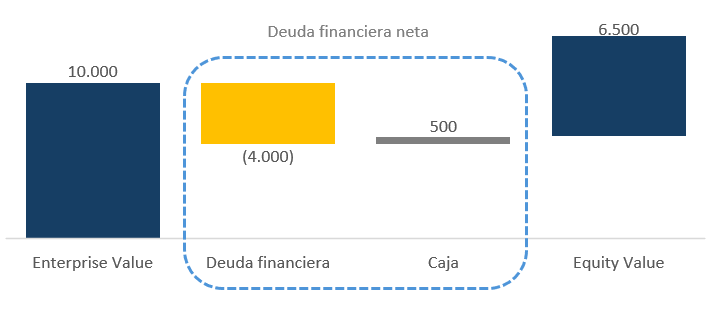
In simple terms, Enterprise Value is the real value of a business considered as a cash-generating unit, and Equity Value is the value of the company as a whole, considering not only the business itself but also net financial debt (financial debt and cash).
But where is the difference between these two concepts? Enterprise Value does not take into account the company’s financing structure, that is, whether the company has a lot or little debt, because it only values the business itself or the operating cash flows. For this reason, this financial metric is defined as the company’s ability to generate cash flows. In contrast, Equity Value is the value that the ownership stake of the owners or shareholders actually has once the company’s debt and cash have been taken into account.
For example, in publicly traded companies, Equity Value is calculated by multiplying the share price by the number of shares outstanding. Therefore, by purchasing 100% of the shares, 100% of the company would be obtained with all its components.
Why Enterprise Value is a key metric in financial consulting
Enterprise Value is fundamental because it allows us to:
- Value companies objectively, without the financing structure affecting their value. That is, it allows the analysis of the business’s ability to generate cash flows, thereby determining its economic value.
- Compare companies with each other, even if they have very different financing structures, since we will focus on how these companies generate “cash.”
- Negotiate corporate transactions such as acquisitions, mergers, or investor entries.
- Apply reliable market multiples, such as EV/EBITDA or EV/EBIT, which are based on operating metrics not affected by the financing structure.
If your company is growing, you are looking for financing or considering a transaction, or you simply want to know the real value of your business, understanding Enterprise Value is an essential step.
How Enterprise Value is calculated
The starting point is to understand that EV includes the entire value of the business, but only the business itself. Therefore, to calculate Enterprise Value we must combine these three elements if we take the company’s overall valuation as the starting point:
- Equity Value — The value of the company’s shares (price per share × number of shares).
- Gross financial debt — Loans, bonds, credit lines, and any financial obligation due.
- Cash and equivalents — Liquid resources that reduce the need for external financing.
Once these components have been obtained, the formula used is:
EV = Equity Value + Gross Financial Debt − Cash and Equivalents
How this calculation is used in a professional valuation
EV is a financial analysis tool that is mainly used to:
- Determine the value of the business before taking into account net financial debt (financial debt minus cash).
- Compare our company or the target company with competitors in the sector using market multiples such as EV/EBITDA or EV/EBIT.
- Analyze scenarios of acquisitions, mergers, or capital increases in corporate transactions.
- Identify value drivers that allow the value of the business to increase.
This approach makes the calculation of EV a central element for making any relevant corporate decision.
In summary: What are Enterprise Value and Equity Value?
In the corporate finance sector, correctly understanding the difference between Enterprise Value and Equity Value is key to obtaining a complete view of a company’s true value. Both metrics offer complementary perspectives: one shows how much the business is worth as an economic whole, and the other reveals the value that actually belongs to the shareholders. Distinguishing them correctly is essential for interpreting valuations, negotiating transactions, and assessing the financial health of any company.
That is why these metrics have become essential tools in acquisition processes, investor entries, or strategic analyses. Having professionals capable of calculating them, interpreting them, and translating them into sound decisions makes the difference between a solid valuation and one that can lead to incorrect conclusions.
At Kea Advisory, we provide you with an expert team that analyzes Enterprise Value and Equity Value with a rigorous, strategic, and fully business-oriented approach. If you are involved in a purchase or sale process, if you are looking to attract new investors, or if you simply want to know the real value of your company, we can support you at every step so you can make decisions with confidence and clarity.